Why predictive maintenance with digital twins matters
Industrial equipment is expensive to operate and costly to repair. Unexpected failures can shut down production, compromise safety, or cause serious damage to connected systems. Predictive maintenance helps avoid these incidents by identifying the early signs of degradation. When supported by a digital twin, the model sees patterns that would be impossible to detect with manual inspections. It can also compare real machine behavior with expected performance in real time, which is often the earliest possible signal that something is wrong.
The financial reasoning behind digital twin-driven predictive maintenance is equally compelling. Many industries face pressure to optimize cost, extend asset lifetime, and improve overall equipment efficiency. Predictive maintenance reduces unplanned stops and shifts maintenance to planned windows. It also decreases spare part consumption and allows smaller maintenance teams to manage larger asset portfolios. These advantages directly translate into measurable return on investment.
How predictive maintenance with digital twins works
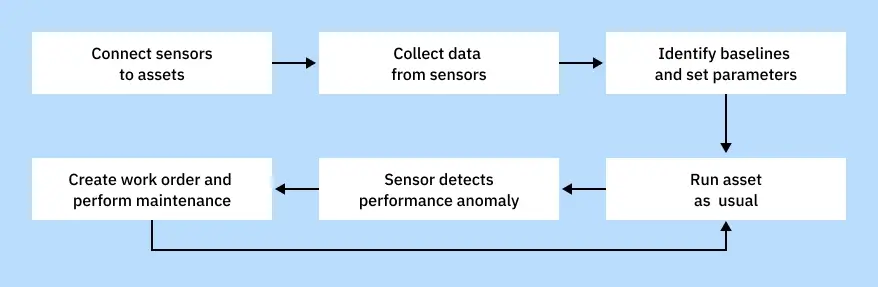
Predictive maintenance systems follow a structured workflow. First, operational data is collected from sensors, SCADA systems, control units, historian databases, and field inspections. This data feeds into the digital twin, which represents the physics, logic, or statistical behavior of the equipment. Next, machine learning, anomaly detection, and state estimation algorithms evaluate how the real equipment compares to the expected model. Deviations beyond normal tolerance ranges are recorded as potential issues. When several deviations appear together, the system predicts a probable failure mode.
A digital twin does more than passively monitor data. It continuously evaluates different conditions and scenarios, helping engineers understand how the asset would behave under different loads or environmental factors. This ability makes the twin an excellent platform for simulating stress, investigating root causes, and verifying whether corrective actions will be effective before applying changes to the real equipment.
Challenges predictive maintenance solves
Predictive maintenance addresses several critical pain points found in asset intensive industries. One of the biggest issues is the lack of early visibility into failures. Many components degrade slowly and show minor symptoms long before they break. These early symptoms are easy to miss without an intelligent monitoring system. Digital twins solve this by detecting deviations between actual and expected behavior with high mathematical sensitivity. This reduces diagnostic uncertainty and lowers the risk of misclassification.
Another challenge is inefficient maintenance planning. Traditional scheduled maintenance often occurs either too early or too late. Too early leads to excessive cost. Too late leads to equipment breakdown and downtime. Predictive maintenance solves this by estimating the optimal intervention window. With digital twins, this estimation becomes much more accurate, because the twin provides additional layers of context, simulation, and validation that traditional statistical models cannot reproduce.
How predictive maintenance can be applied across industries
Industries with high capital costs benefit the most from predictive maintenance. In manufacturing, for example, digital twins support the condition monitoring of CNC machines, compressors, pumps, and conveyors. In energy systems, they are widely used to track the health of transformers, solar inverters, turbine bearings, and cooling units. Similarly, oil and gas operations rely on digital twins to assess drilling rigs, pipelines, and compressor stations. In logistics, predictive maintenance is applied to vehicle fleets and material handling equipment. In addition, commercial buildings gain value through digital twins that monitor HVAC systems, chillers, and power distribution assets.
Data centers represent another critical application area. In this environment, cooling infrastructure, UPS systems, and power electronics are highly sensitive to gradual degradation. As a result, digital twins help identify unstable thermal behavior, load imbalances, and early power quality issues before they escalate. Consequently, outages are prevented and uptime improves. Overall, across all these sectors, predictive maintenance delivers the same core advantage: reduced downtime and stronger operational resilience.
How to choose the right predictive maintenance approach
Selecting a predictive maintenance solution requires evaluating four major criteria. First is the type of asset. Some assets benefit from physics based models, while others require data-driven models. Equipment with well-understood physical behavior, such as hydraulic cylinders or rotating shafts, can be represented using analytical models. Equipment with complex multi variable patterns, such as industrial HVAC or electrical converters, performs better with machine learning driven twins.
Second is data availability. Predictive maintenance relies on high-quality data streams. If historical data is limited, hybrid models that combine rules, physics, and ML often work best. Third is integration capability. The solution must connect with existing automation layers and business systems. Finally, operational maturity plays a role. Organizations with advanced maintenance processes get better results from high resolution digital twins, while those at early stages may prefer simpler models that still deliver actionable insights.
Significant differences compared with other maintenance methods
Predictive maintenance differs from corrective, preventive, and prescriptive maintenance in several ways. Corrective maintenance is reactive and initiated only after failure has occurred. Preventive maintenance follows fixed schedules regardless of actual asset health. Predictive maintenance focuses on condition assessment and probabilistic failure forecasting. It reduces operational waste and aligns the intervention with the real condition of the asset.
Prescriptive maintenance goes one step further by recommending optimal actions. Predictive maintenance combined with digital twins can be considered a more advanced version of prescriptive maintenance, because the digital twin simulates the impact of each action before deployment. This capability is unique. Traditional predictive systems often lack detailed simulation, leading to uncertainty. Digital twins close this gap and offer a more reliable and interpretable decision support environment.
Key benefits of predictive maintenance with digital twins
The benefits of this approach fall into operational, financial, and strategic categories. From an operational standpoint, the biggest advantages are early fault detection, improved asset reliability, and reduced downtime. Digital twins give maintenance teams continuous visibility into asset behavior. Teams can plan interventions more efficiently and respond quickly to anomalies. This increases system stability and prevents cascading failures.
The financial benefits are equally strong. Predictive maintenance helps extend asset life, reduce overtime costs, improve spare parts planning, and eliminate unplanned stoppages. Strategic benefits include better safety, improved sustainability metrics, and stronger decision making at the organizational level. Over time, organizations with digital twin driven predictive maintenance develop a more resilient operational culture supported by data and simulation.
Current limitations of predictive maintenance
Data availability and operational context challenges
Predictive maintenance has strong potential, but building a full predictive ecosystem is still difficult for many organizations. One of the main challenges is reliable data availability. Many assets operate with limited instrumentation or sensors that produce noisy, inconsistent, or incomplete data. Without high quality measurements collected over long time periods, training robust predictive models becomes extremely difficult. Even in fully monitored facilities, failures occur infrequently, which creates imbalanced datasets and limits model accuracy.
In addition, predictive systems require more than raw sensor readings. They also depend on operational context such as workloads, environmental conditions, maintenance logs, and operator actions. These data streams are often distributed across SCADA, MES, ERP systems, and manual spreadsheets without a unified structure. As a result, predictive models may lack the full picture and misinterpret normal operational variation as anomalies. Many organizations discover that data harmonization and semantic modeling are more challenging than the predictive analytics itself.
Cost, complexity, and adoption limitations
Another major limitation involves cost and system complexity. Developing physics based models or training machine learning systems requires specialized expertise, dedicated infrastructure, and ongoing monitoring of model drift. As equipment ages, usage patterns change, or operating conditions shift, models must be recalibrated to remain reliable. For many organizations, especially mid sized manufacturers and utilities, this level of effort and investment is difficult to justify.
This is why flexible, modular platforms are gaining traction. They allow companies to adopt predictive capabilities gradually instead of committing to full scale predictive maintenance from the start. Once foundational data collection, monitoring, and modeling are in place, external predictive engines can be connected when needed. This approach reduces risk, lowers initial costs, and provides a more realistic pathway toward advanced maintenance strategies.
How CENTO supports predictive maintenance
Modular foundation for predictive maintenance
CENTO approaches predictive maintenance through a modular and accessible framework that allows companies to strengthen their maintenance processes without implementing complex ML systems from day one. The platform focuses on enabling early detection, structured visibility, and operational intelligence through tools that work immediately after deployment.
The foundation of CENTO’s predictive capabilities is its alarm and notification system. Operators can configure thresholds for any tag or channel and receive alerts when values deviate from acceptable ranges. Thresholds can be static, condition based, or tuned to reflect how specific equipment behaves. This creates a practical first layer of predictive protection and helps detect abnormal situations before they escalate into faults.
Digital twin modeling and system simulation
CENTO’s semantic information model provides the structural layer that ties equipment, processes, and operational data together. This makes it possible to simulate system behavior, understand interdependencies, and evaluate how different conditions influence asset performance.
For electrical systems, the loadflow module extends this capability by calculating currents and voltages across networks. Operators can simulate abnormal operating modes such as overloads or emergency shutdowns and evaluate the consequences before they occur, reducing operational risk.
Try CENTO in action. Run our demo.
Historical analysis and extended visibility
Historical data is automatically recorded in the historian module, which provides a complete event record for every metric. This simplifies root cause analysis by allowing operators to replay data and identify the exact sequence of events leading to an incident.
The video monitoring module adds an additional layer of visibility by enabling real time observation of assets within the same interface. Combined with historical and modeled data, this gives teams a more complete understanding of asset behavior.
Integration with external predictive analytics
CENTO is designed to work alongside external AI or ML predictive maintenance systems. Through integration interfaces and custom modules, organizations can connect CENTO to any external predictive engine or analytics platform.
This enables a hybrid approach in which CENTO manages data ingestion, alarms, simulation, and visualization, while external models deliver advanced analytics when required. As a result, companies can scale predictive maintenance capabilities at their own pace without investing in complex systems upfront.
How to start with predictive maintenance in CENTO
Starting with CENTO is straightforward. After defining the target assets, CENTO connects to available data sources. The system maps tags, configures data ingestion pipelines, and builds the initial digital twin models. For early stages, organizations often begin with a single asset class to validate the workflow. Once stable results are achieved, it is simple to expand to additional equipment categories. CENTO also provides templates for pumps, transformers, HVAC units, and manufacturing machines.
During the onboarding phase, CENTO sets up anomaly scoring and event thresholds. These thresholds are adjusted based on historical patterns, operational targets, and safety limits. Maintenance teams can then review insights in the CENTO dashboard. The interface displays performance baselines, predicted degradation patterns, and suggested maintenance windows. Over time, the digital twin fine tunes itself as more operational data becomes available, increasing prediction accuracy.
Integration with SCADA, MES, and ERP systems
CENTO is designed to integrate seamlessly with industrial automation and enterprise systems. For real time data, it connects with SCADA systems through OPC UA, Modbus, MQTT, or direct historian access. This ensures continuous and reliable sensor data for the digital twins. For production and process related information, CENTO integrates with MES platforms. This provides valuable context such as batch information, production schedules, or workload variations that influence asset behavior.
ERP integration supports the logistical side of maintenance. By synchronizing work orders, spare parts lists, and maintenance calendars, CENTO creates a closed loop predictive maintenance environment. When an anomaly appears, CENTO can automatically generate maintenance tasks or send notifications to the responsible team. This reduces manual administration and improves operational discipline. Most importantly, the integration ensures that predictive maintenance results translate into real corrective actions on the shop floor.
Move forward with predictive maintenance
CENTO uses digital twins to turn predictive maintenance into a practical, scalable capability. The next step is to see how this works in real operating conditions. Request access to the CENTO demo environment to explore live dashboards, digital twin models, and predictive workflows, or schedule a guided demo session with our team for a focused walkthrough based on your industry and asset types.
For a deeper evaluation, start with a free operational assessment. This helps identify the assets with the highest predictive maintenance potential, assess data readiness, and define how CENTO can integrate with your existing SCADA, MES, and ERP systems. You can also review related sections on digital twin architecture and real time monitoring to understand how CENTO supports long term operational resilience.
Take the next step toward more reliable assets, fewer unplanned failures, and data driven maintenance decisions with CENTO.
FAQ: Predictive maintenance for manufacturing
Q: What is predictive maintenance in CENTO?
A: Predictive maintenance in CENTO is an approach that uses digital twins, real time data, and system modeling to detect abnormal behavior early and support maintenance decisions before failures occur.
Q: Does CENTO require machine learning to start predictive maintenance?
A: No. CENTO is designed to deliver predictive value without complex ML models at the initial stage. Thresholds, alarms, historical analysis, and digital twin simulations provide actionable insights immediately, with the option to add external ML later.
Q: Which assets are best suited for predictive maintenance with CENTO?
A: CENTO is commonly used for pumps, motors, transformers, HVAC systems, production equipment, power distribution assets, and other critical infrastructure where downtime or degradation creates operational risk.
Q: How does CENTO integrate with existing systems?
A: CENTO connects to SCADA systems using OPC UA, Modbus, MQTT, and historian interfaces. It also integrates with MES and ERP systems to synchronize production context, maintenance activities, and asset data.
Q: Can CENTO work with third party predictive analytics platforms?
A: Yes. CENTO supports integration with external AI and ML engines. The platform manages data ingestion, visualization, alarms, and simulation, while third party systems can provide advanced predictive analytics when needed.
Q: How long does it take to start using predictive maintenance in CENTO?
A: Initial deployments can be completed quickly once data sources are connected. Many organizations begin with a limited set of assets and expand gradually as models and workflows mature.
Q: What business benefits does CENTO deliver?
A:CENTO helps reduce unplanned downtime, improve asset reliability, extend equipment life, and support more efficient maintenance planning through data driven insights and digital twin simulation.