
18 min. read

Digital twins have become one of the most important foundations of modern manufacturing. In 2025 the term no longer describes a simple 3D model or a visual replica of a machine. A digital twin is a live, data driven virtual system that reflects industrial asset behavior in real time. Manufacturing teams use digital twins to see how equipment reacts under load, how processes change and how to optimize resources without stopping production. This shift from static documentation to dynamic simulation marks a turning point for industrial operations.
The rise of digital twins is closely tied to three factors:
Latest research shows that digital twins are moving from isolated pilots to enterprise scale architectures that operate continuously with real time data feeds and hybrid analytics.
A digital twin in manufacturing has three essential components. The physical layer consists of machines, devices, controllers and sensors that generate operational data. The virtual layer contains a detailed model of equipment and its behavior. The data layer captures signals, updates the virtual model, and sends instructions to the physical system when needed. As a result, this creates a foundation for predictive maintenance, energy optimization, and what-if simulation.
Modern digital twins go beyond simple mirroring. They integrate semantic information models, process logic and standardized communication flows. Additionally they support visualization layers, 3D reconstruction methods and physics based models.
According to recent researches, this combination allows twins to react to equipment degradation, simulate failures and test strategies for optimization. This is why digital twins are becoming a central component of Industry 4.0 initiatives across manufacturing sectors.
If you want to see how this architecture works inside a real platform, explore the CENTO architecture overview.
Or read about what is CENTO and how it transforms enterprise operations into a unified digital twin, enabling energy consumption clarity, cost savings, sustainable growth and even more in our article.
Or read about what is CENTO and how it transforms enterprise operations into a unified digital twin, enabling energy consumption clarity, cost savings, sustainable growth and even more in our article.
The physical layer includes machines, robotics cells, conveyors and all sensors that collect operational behavior. These sensors record vibration, torque, thermal signatures, electrical load and other process signals at high frequency. The precision of this data defines digital twin accuracy, as each simulation step depends on real measurements captured at the equipment level.
Real time acquisition is essential for reflecting true machine states. In practice, digital twins in manufacturing require dense and consistent data streams to maintain accurate state representation. Without this foundation, higher layers of the architecture cannot generate reliable predictions or simulations, which means the entire system becomes less trustworthy and less effective.
This layer collects raw signals through OPC UA, MQTT and controller channels. Gateways aggregate these signals and send them to edge devices where filtering, normalization and buffering occur. The result is a consistent data stream prepared for semantic interpretation and model generation. The primary purpose of edge processing is to reduce latency and stabilize real time workloads.
Model based engineering research highlights that well structured data pipelines accelerate digital twin creation. Unified schemas allow production lines to be converted into digital structures more quickly, enabling automatic updates as manufacturing processes evolve.
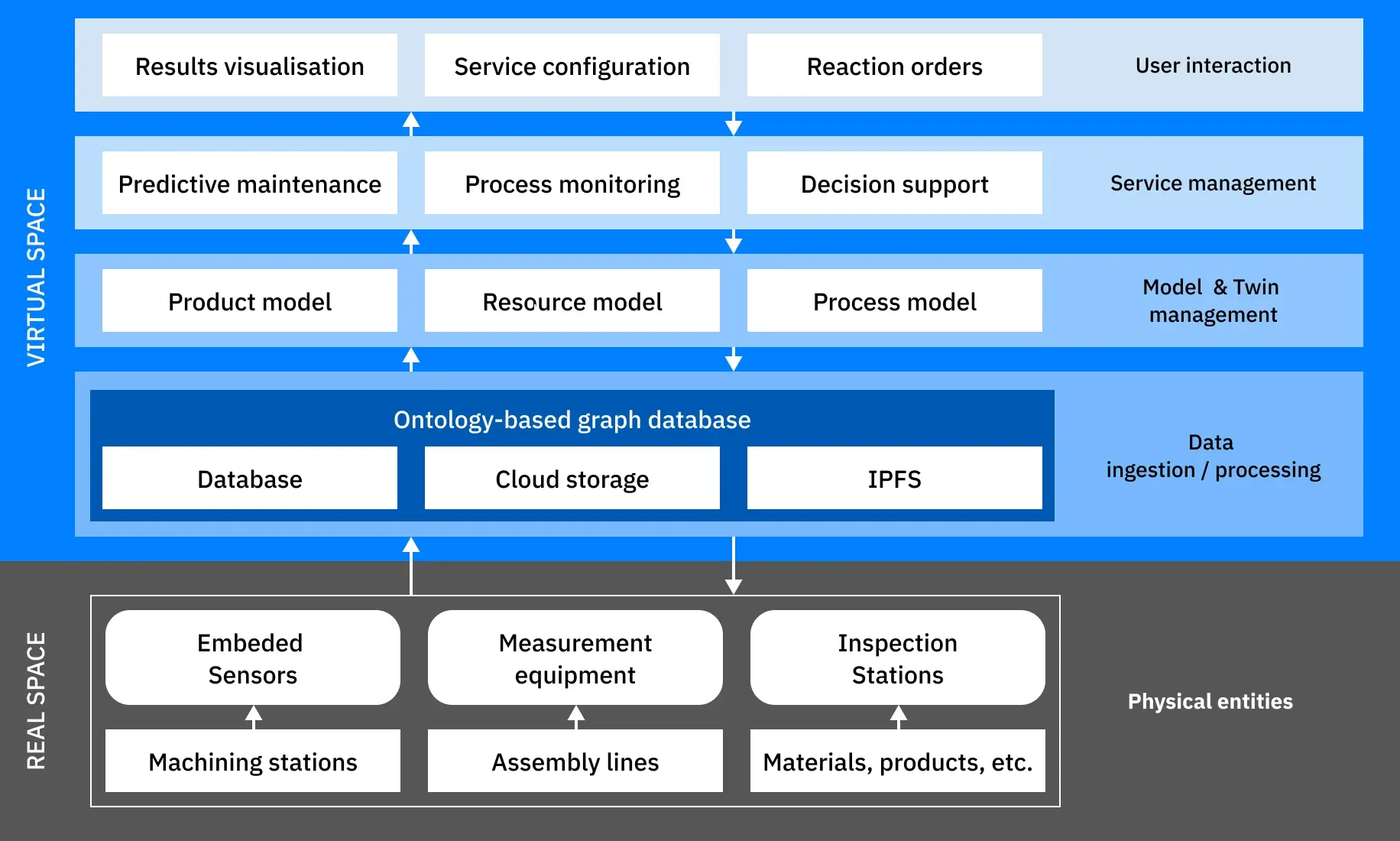
The semantic layer describes equipment as structured entities with attributes, states and relationships. It transforms raw signals into meaningful information, allowing analytics and simulation systems to understand the functional role of each asset. This layer acts as the logical core that integrates equipment identity, process context and operational constraints.
ISO 23247 offers a standardized structure for representing manufacturing systems and interactions. It ensures that digital twins remain consistent across different production scenarios and supports scalable enterprise adoption. This creates a strong foundation for interoperability and real time decision making.
This layer contains the digital representation of machines and production lines. It may include geometric CAD models, physics based simulations or high fidelity 3D reconstructions. These models allow teams to test scenarios, analyze behavior and evaluate changes without interrupting actual operations. They also support visualization, training and layout validation.
New research in 2025 shows that vision based approaches, including 3D Gaussian Splatting, can reconstruct production environments from image sequences with impressive accuracy. This significantly reduces modeling time and allows digital twins to update more frequently as equipment changes over time.
The intelligence layer combines condition monitoring, anomaly detection and predictive analysis. It evaluates sensor patterns, identifies deviations and estimates how equipment will behave under different load conditions. This layer turns the twin into an intelligent system that supports maintenance decisions and drives process improvements.
Hybrid predictive models integrate real time signals with simulated behavior to forecast degradation and future states. According to recent research, these models improve decision making and reliability by giving early insight into equipment health in manufacturing.
A manufacturing digital twin relies on a semantic structure describing each asset and its behavior in the production environment. Information models define machines with states, roles, and constraints, helping the twin understand each signal and its purpose. Without this semantic clarity, a twin becomes little more than a data visualization tool. Manufacturing processes require context aware interpretation because each machine affects quality, throughput and energy performance in a different way.
Semantic information models also create a unified language for integrations. They make data from PLCs, historians, SCADA systems and sensors interoperable, which improves consistency across factories and reduces engineering overhead. This structure supports advanced features such as real time reasoning, model based configuration and accurate simulation. By adding meaning to raw industrial data, semantic models enable twins that guide decisions, detect anomalies, and adapt to production changes.
ISO 23247 defines a complete reference framework for digital twins of manufacturing systems. It describes entities such as machines, work cells, production lines and interactions between them. The standard ensures a predictable digital representation of the physical environment, which supports scalable deployments across multi line factories. ISO 23247 defines how information moves between physical and virtual layers, enabling consistent behavior in complex manufacturing environments.
The value of ISO 23247 becomes clear when manufacturers introduce new equipment or modify production layouts. Instead of rebuilding twin logic from scratch, engineers update entity definitions and the digital model stays aligned with the physical system. This structured approach improves maintainability and reduces integration time. A well defined information model accelerates predictive maintenance and optimization, because analytics tools use consistent machine identities and operational relationships.
Information models transform a digital twin from a passive replica into an intelligent system. By describing equipment behavior, states, and interactions, these models let analytics engines detect patterns invisible in raw data.
They reveal dependencies, trace deviations, and predict how failures in one component may spread through the production line. Such capability is essential for high value use cases like predictive maintenance, throughput optimization and energy analysis.
Information models also allow the twin to simulate scenarios with precision. When the system understands machine limits, workflow sequences and resource constraints, simulations become more accurate and actionable. This supports what-if analysis, commissioning, layout redesign and performance tuning. Academic research confirms that digital twins built on strong semantic models provide better prediction accuracy and more stable decision support.
Modern factories evolve quickly and need digital twins that adapt to frequent changes in equipment, workflows, and layout configurations.Manual modeling becomes a bottleneck because engineers must recreate or update models whenever machines are replaced or processes are redesigned. Automated generation speeds up this lifecycle by extracting structure, behavior and configuration parameters directly from engineering data. This reduces deployment time for new twins and ensures models stay accurate during equipment changes and system expansions.
Automation also reduces variability in model quality. Instead of relying on subjective interpretation, the system uses standardized inputs like machine descriptions, control logic, and layout information. Research shows that automatic extraction of machine functions and process relationships improves consistency, lowers engineering workload and enables more reliable simulation of real factory behavior. These capabilities are essential for manufacturers aiming to scale digital transformation across multiple sites.
Model based engineering provides the rules for converting engineering artifacts into digital twin structures. It uses descriptions from AutomationML, CAD models and controller logic to create a structured representation of each machine. The system can then assemble these components into a functional virtual environment. This method eliminates manual recreation of equipment behavior and allows twins to inherit the logic already defined during system design. When combined with semantic information models, it enables faster commissioning and easier updates over the equipment lifecycle.
Recent research shows that integrating model based engineering with AI driven workflows improves flexibility and reduces configuration time. AI tools can identify missing attributes, generate workflow diagrams such as BPMN and fill semantic gaps in equipment descriptions. This approach lets factories deploy twins earlier in the project timeline, supporting validation, layout testing, and early detection of design flaws. Automated generation also ensures that digital twins stay synchronized as engineers introduce new production constraints or modify resource allocation.
Automated digital twin creation produces models that can connect to live data streams immediately after deployment. Because the models follow structured engineering inputs, they integrate easily with historian data, SCADA signals, and real time monitoring systems. This alignment allows manufacturers to run scenario simulations, validate process changes and analyze equipment behavior without halting production. Automated generation therefore shortens the path from model creation to operational use, supporting faster decision cycles on the factory floor.
A consistent and automatically generated twin also simplifies predictive maintenance workflows. When the system understands machine topology, dependencies, and operational constraints, analytics engines evaluate anomalies with greater precision. Recent studies show how automatic modeling strengthens predictive insights in digital twin driven maintenance. Automated generation keeps the twin aligned with equipment updates, improving predictive accuracy and long term reliability.
Launch demo to explore CENTO features
or book a guided walkthrough
Real time synchronization allows a digital twin to reflect the current condition of each machine without delay. Manufacturing environments require continuous updates because equipment states can shift under load, temperature changes or dynamic process constraints. Real time data streaming captures these variations and delivers them into the twin at a stable frequency. As a result, the virtual model stays aligned with the actual equipment state, which is essential for simulation accuracy, quality control, and predictive maintenance.
When the digital twin receives synchronized data streams, it can perform detailed evaluations of production behavior. This includes detecting micro deviations, analyzing vibration cycles and predicting performance drops. By maintaining a synchronized state, the system also supports energy monitoring and throughput optimization. Real time synchronization lets the digital twin act as an intelligent companion, enabling manufacturers to validate changes and respond to unexpected events.
Latency plays a significant role in the reliability of manufacturing digital twins. When data arrives late or out of order, simulation accuracy declines and automated decisions may become unsafe. To avoid drift between physical and virtual states, manufacturers use edge processing to stabilize the twin data pipeline. Edge nodes filter, compress and reorder incoming signals before forwarding them to the central platform. This keeps the update cycle predictable and maintains the quality of service required for real time decision support.
Stable data pipelines also improve predictive performance. When the system receives low latency signals, algorithms identify equipment degradation earlier and assess how local variations affect downstream processes. Research shows that manufacturing twins with consistent latency profiles produce more accurate forecasts of failure modes and process bottlenecks. This gives operators a clearer view of equipment behavior under specific conditions and lets them test mitigation strategies without stopping production.
AI expands the capabilities of digital twins by generating parts of the model automatically. Instead of modeling each asset manually, AI analyzes engineering files, sensor data, and controller logic to build a structured equipment representation. It identifies machine functions, extracts workflow patterns, and creates behavior rules that define system reactions to load or environmental changes. Such AI generated digital twin models reduce engineering hours and improve model consistency across production sites.
AI also updates the digital twin as the physical environment evolves. When machines age, workflows change or new configurations are introduced, AI tools detect these shifts and adjust model parameters. This supports adaptive manufacturing twin design where the virtual model remains aligned with real equipment. Research shows that automatic model refinement improves predictive accuracy and reduces the time needed to validate design changes or run what-if analysis.
Vision based techniques enhance digital twins by creating detailed 3D reconstructions of production lines. Camera streams capture equipment geometry and movement, while 3D Gaussian Splatting turns these images into high fidelity digital surfaces. This lets the twin reflect the real environment more accurately, especially when CAD data is outdated or incomplete. The combination of visual reconstruction and sensor readings creates a data driven equipment simulation model that supports deeper operational insight.
AI also powers hybrid simulation models that merge physical behavior with machine learning predictions. These models forecast machine states, detect anomalies early, and test corrective actions in the virtual environment before real deployment. This predictive intelligence reduces risk and improves throughput by letting operators test strategies without interrupting production.
A digital twin acts as a continuous reference model for machine health. Instead of using only historical signals, the twin evaluates equipment behavior in real time and compares it with expected performance. This creates a more reliable predictive maintenance model because the system identifies early deviations that traditional monitoring cannot detect. When the virtual model understands normal operating ranges, it estimates equipment stress, thermal drift, and vibration anomalies with higher precision.
Digital twins also support predictive health estimation by combining sensor data with simulated behavior. When conditions change, the twin checks whether the equipment matches its expected response. If the machine reacts differently, the system marks it as a potential degradation event. This hybrid analysis improves forecasting accuracy and reduces false alarms. It becomes easier to schedule maintenance at the right time and avoid unnecessary stops.
A key advantage of digital twin driven predictive maintenance is the ability to simulate failures before they occur. The twin can run virtual scenarios where load increases, mechanical constraints are stressed or environmental factors vary. These simulations reveal how specific components may deteriorate over time. They also help predict failure modes that appear only under certain process conditions. This is especially valuable for rotating equipment, conveyors and automated production cells.
Digital twins also support long horizon degradation forecasting. Hybrid models evaluate slow wear mechanisms, lubrication loss, thermal fatigue and alignment issues. Research shows that combining simulated behavior with real data improves failure prediction windows and reduces maintenance uncertainty. This allows manufacturers to shift from reactive repairs to condition based lifecycle management, which lowers costs and improves asset availability.
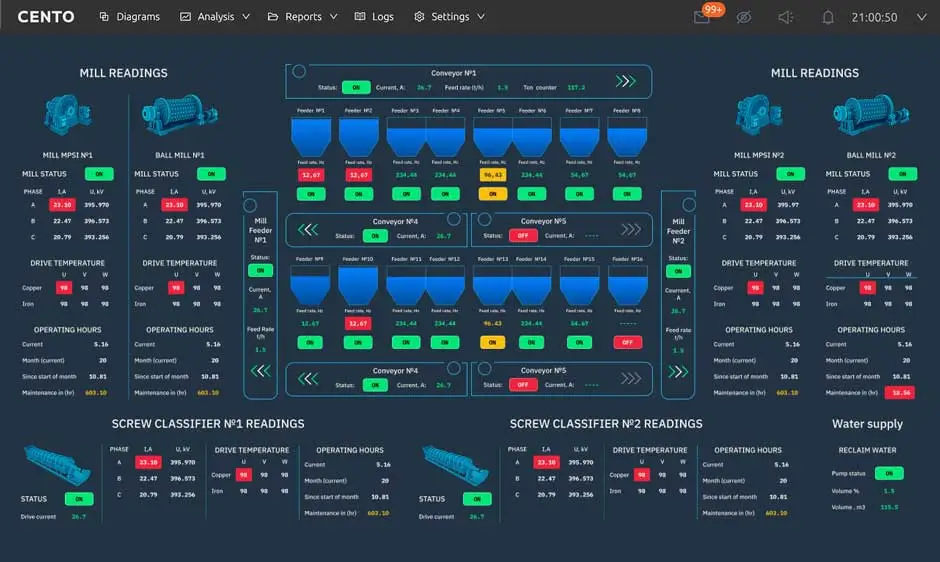
Digital twins connect to SCADA systems to receive stable real time signals that describe equipment states, alarms and process parameters. SCADA provides the operational backbone for manufacturing, so its data becomes a primary input for the twin’s behavior model. With this connection, the system supports low latency state updates, alarm context interpretation and event driven model adjustments. As a result, the digital twin reflects process transitions and machine states as they occur, improving decision accuracy during operations and maintenance.
Furthermore, a digital twin SCADA integration allows the system to validate operator actions and control sequences before execution. When SCADA events flow into the twin, the virtual model simulates how adjustments affect line performance, energy demand and equipment stability. This, in turn, enhances the safety of process changes and supports continuous improvement initiatives. Overall, real time alignment between SCADA and the twin ensures that simulation results match real production behavior, strengthening trust in predictive analytics and optimization workflows.
When a digital twin connects to MES, it gains insight into production orders, workflow sequences, quality checkpoints and process constraints. This connection allows the twin to understand how equipment behaves and why it behaves that way within the production schedule. MES data supports detailed process modeling and provides the operational logic needed for accurate simulation. This enables a digital twin MES connectivity pattern where production operations and equipment behavior stay tightly linked for better planning and analysis.
The integration also improves traceability and process validation. The digital twin uses MES instructions to simulate alternative routing, detect bottlenecks and evaluate the impact of order changes. This helps manufacturers optimize throughput, reduce setup time and manage resource allocation more efficiently. Combining MES logic with virtual equipment behavior makes the twin a strategic tool for production optimization and short interval planning.
ERP systems hold information on inventory, procurement, cost structures and workforce planning. When the digital twin connects to ERP, it becomes capable of evaluating operational scenarios at the enterprise level. For instance, the twin can simulate how equipment downtime affects order fulfillment or how energy price changes influence production schedules. As a result, this erp to digital twin data exchange creates a comprehensive view of factory performance, linking physical operations with financial outcomes.
In addition, enterprise integration strengthens long term planning. The digital twin can use ERP data to evaluate capacity expansion, equipment investment and maintenance budgets. By doing so, it simulates how asset performance affects financial results and identifies high impact improvement opportunities. Ultimately, this cross system connection turns the digital twin into an enterprise decision framework rather than a purely engineering tool. It supports strategic planning, risk reduction and resource optimization across the entire organization.
A practical digital twin deployment begins with selecting priority assets and defining a narrow initial scope. Manufacturers first identify machines that influence downtime, energy usage or production flow. This focused approach reduces engineering complexity and ensures early measurable results. Once the scope is set, teams create the semantic layer that defines equipment identity, operating states and relationships. ISO 23247 serves as a reference for structuring these definitions and establishing a consistent model foundation.
After the semantic structure is ready, engineers connect real time data sources such as PLCs, SCADA and edge devices. These pipelines synchronize the twin with physical equipment and allow the system to evaluate behavior with minimal latency.
Next, teams develop the virtual model using CAD files, physics based logic or 3D reconstruction methods. Quick simulation cycles help validate how accurately the model reflects real equipment behavior and highlight parameters that require adjustment.
Once validated, predictive analytics are deployed to forecast failures, detect early anomalies and analyze process efficiency.
Dashboards present these insights to operators, turning the digital twin into a decision tool that improves uptime, reliability, and resource planning.
Digital twins provide measurable returns by reducing equipment downtime, improving failure prediction accuracy and optimizing resource use. As they evaluate machine behavior continuously, twins detect early signs of degradation and prevent shutdowns that lead to production losses. In many cases, hybrid predictive models extend asset life and reduce maintenance effort by aligning service schedules with real operating conditions.
In addition, a digital twin improves operational efficiency through simulation based planning. Manufacturers use the virtual model to test workflow changes, evaluate energy patterns and study how configuration choices affect throughput. As a result, these insights help reduce scrap, shorten setup times and balance production loads. Furthermore, predictive analytics increase financial impact by lowering spare part costs, preventing cascading failures and improving maintenance team utilization.
Ultimately, the combination of reduced downtime, longer asset lifespan and more accurate decisions creates strong ROI, especially in multi line factories.
Despite their value, digital twins face several challenges that affect deployment speed and system performance. However, the most common limitation is inconsistent data quality. Manufacturing equipment often produces noisy signals, missing values or irregular sampling rates, and this reduces the accuracy of real time behavior. As a result, unreliable data causes virtual models to drift away from physical conditions, and predictive insights become less trustworthy. In addition, synchronization drift appears when latency rises or when edge devices fail to deliver stable data, which makes it harder for the twin to reflect true machine states.
Another challenge is the complexity of model creation and calibration. Even though automated generation methods help, some equipment types require detailed behavior modeling that standard tools cannot fully capture. Vision based reconstruction supports geometry, but many mechanical behaviors are not visible to cameras, which limits how complete the virtual model can be.
Moreover, integration with legacy SCADA or MES systems remains difficult, because outdated platforms often do not expose the structured data needed for semantic models. Consequently, scalability becomes a concern when the digital twin must operate across many lines or factories that rely on different control logic or equipment vendors.
Because of this, manufacturers need strong data governance, reliable pipelines and unified semantic structures. Finally, addressing these challenges creates a foundation for accurate, scalable and long lasting digital twin deployments.
Digital twins have become a central element of modern manufacturing strategy. Their ability to mirror equipment behavior, evaluate conditions, and predict failures makes them essential for data driven operations in 2025. As factories adopt more sensors, advanced analytics, and semantic models, digital twins evolve into scalable real time optimization systems. Reliable data pipelines, adaptive models, and predictive intelligence give manufacturers a powerful tool to improve uptime, cut costs, and build resilience.
Future deployments will focus on interoperability and enterprise scale integration. Semantic standards like ISO 23247, automated model generation, and hybrid simulation unify equipment data across lines and sites. As these technologies mature, digital twins become integrated operational systems that guide maintenance, planning, and resource management. Therefore, this transformation positions digital twins as a core infrastructure layer for industrial digital transformation rather than a specialized feature.
CENTO delivers a unified industrial platform combining real time data pipelines, semantic modeling, advanced analytics, and predictive intelligence. If you need a digital twin that scales across your factory, aligns with ISO standards, and integrates with SCADA, MES, and ERP, explore CENTO case studies and request a demo.
Share your details and let’s start the conversation.
Share your details and let’s start the conversation.
Launch demo to discover some of product features.
Login: demo
Password: demo
If you need more information and guided demo – contact our team to book a call.