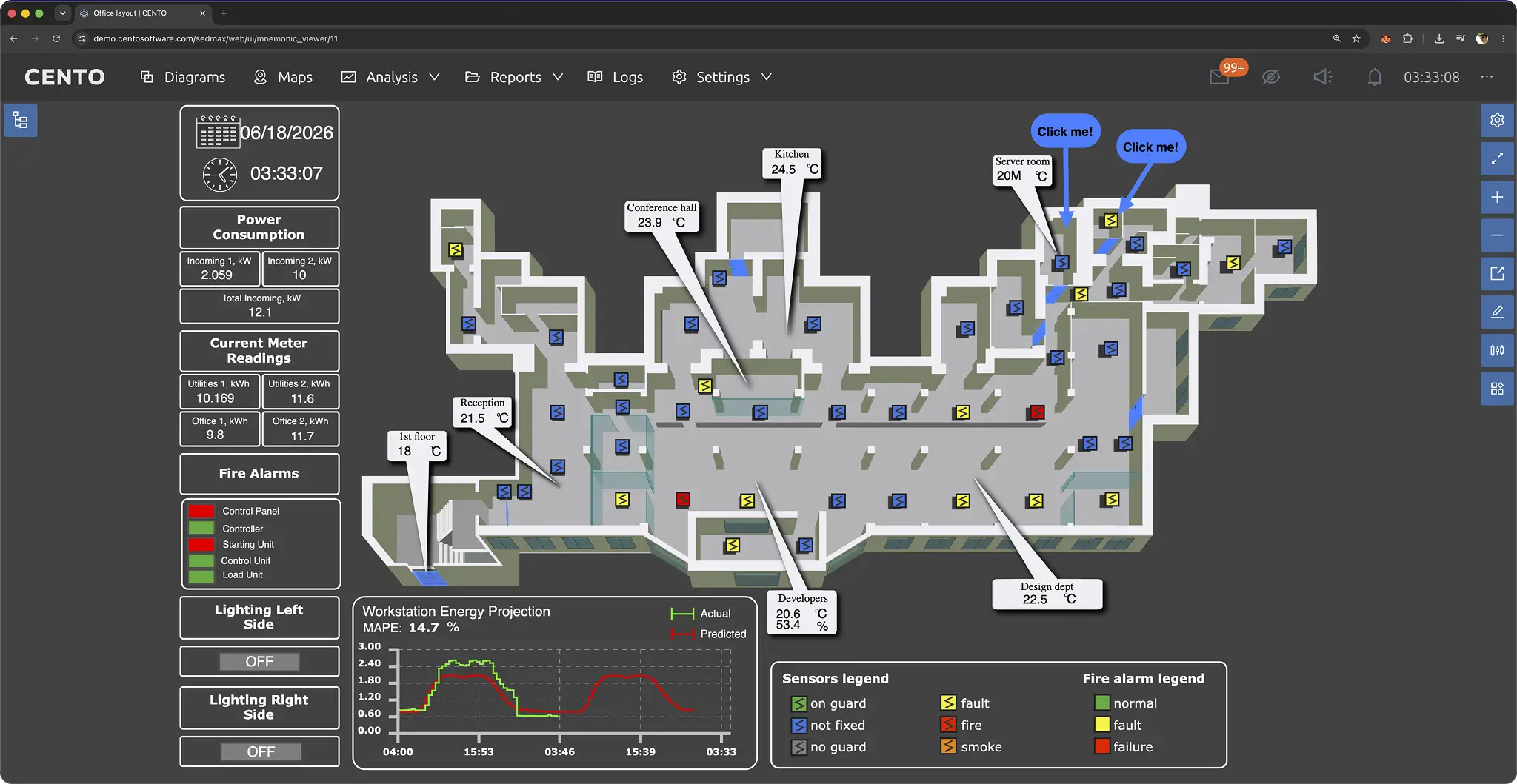
An industrial energy management system has to cross several boundaries at once. Energy managers need defensible indicators and reports, while operators need timely information that respects production constraints. OT teams require stable, secure acquisition, and finance needs costs tied to the correct tariff and cost center. If these groups work from separate project definitions, a technically successful integration can still produce a dashboard that nobody uses.
There is also a terminology problem. This article uses EMS for the software and data layer that collects, contextualizes, analyzes, and reports energy information. It uses EnMS for the organizational energy management system described by ISO 50001. ISO 50001 provides a technology-neutral management framework; it does not prescribe a particular software product, and buying software does not establish conformity or certification.[1]
The implementation path therefore has two connected workstreams. One establishes scope, responsibilities, indicators, action plans, and review. The other connects meters and operational systems, preserves data quality, and turns the agreed methods into repeatable digital workflows. For a broader explanation of the category and architecture, start with the industrial energy management system guide. The roadmap below focuses on moving from intent to an accepted pilot without disrupting production.
Why can an EMS implementation fail before software goes live?
A dashboard-first project makes its first choices too early. The team selects meters, tags, intervals, screens, and reports before defining the management boundary or operational questions. The values may be accurate but difficult to interpret. A power increase could reflect waste, a product change, a maintenance test, or higher output. Software cannot select the valid explanation without context and an agreed method.
Ownership gaps create the second failure mode. An alert can identify a deviation, yet no improvement occurs if nobody has authority to investigate it, if the response conflicts with a production target, or if maintenance cannot see the evidence behind it. The practical unit of implementation is not a connected data point. It is a complete decision loop: measure, interpret, assign, act, verify, and review.
ISO 50005 supports phased implementation. Its model uses twelve core elements and four maturity levels to help organizations build toward ISO 50001, while not covering every requirement.[2] The first release can be small, but the team must know which management and technical capabilities are inside the phase and which remain planned.
How do you define scope and decisions before choosing data points?
Start with a written boundary naming the site, production area, utilities, energy carriers, responsible teams, and operating periods in the pilot. State what is outside scope. A line-level project may include the line, its compressed-air branch, cooling circuit, and production orders while excluding the central boiler house. That is acceptable when the effect on results is understood.
Energy management system boundary: The formally approved organizational, physical, and operational scope within which energy uses, data sources, responsibilities, and improvement results are managed.
Write the decisions the pilot must support, such as investigating abnormal shift energy intensity, identifying idle consumption, reconciling a departmental balance, or verifying a completed action. Give each decision an owner, response time, and evidence need. Those fields determine the data and workflow design.
Decide whether the goal is internal improvement, alignment with ISO 50001, or preparation for certification. ISO describes certification as possible but not obligatory.[1] Audit-ready conformity needs stronger document control and traceability than a limited operational pilot. Record the distinction before procurement so software acceptance and management-system evidence are not confused.
How do you identify significant energy uses and needed context?
A structured energy review connects the boundary to the pilot scope. ISO 50002-1:2025 defines a general energy-audit method and can support the ISO 50001 energy review or be used independently.[3] The useful output is a prioritized view of where energy is consumed, what influences it, and where operational change is material and feasible.
Significant energy use (SEU): An energy use selected because it represents substantial consumption, considerable improvement potential, or both under criteria defined by the organization.
The largest load is not automatically the best pilot. A furnace may dominate consumption but offer little flexibility under strict temperature and quality constraints. A smaller compressed-air system may have clearer states, measurable output, and avoidable runtime. DOE guidance allows SEU selection to consider consumption and improvement potential, with thresholds set by the organization.[5]
For each candidate SEU, map the energy signal and variables required to interpret it. Meter values may need equipment state from SCADA, output from MES, maintenance status, and tariff context from ERP. Keep only variables that change the decision; treating every tag as necessary makes the pilot harder to validate.
How do you verify data quality before expanding metering?
Inventory existing sources before specifying new hardware. For each required signal, record its asset, unit, interval, timestamp source, quality flag, history depth, owner, and interface. Test continuity across normal production, changeovers, planned stops, and communication interruptions. A live value does not prove the history can support a baseline.
Energy data collection plan: A maintained specification of which energy and relevant-variable data is collected, how often, at what quality, by whom, and for which analysis.
DOE guidance calls for identifying energy sources and uses, relevant variables, responsibilities, collection needs, accuracy, repeatability, and analysis methods.[4] This turns a tag list into a governed plan and separates measurement gaps from integration gaps. If a meter stores interval data but cannot be matched to a line or cost center, another meter will not solve the problem.
Add instrumentation only when an agreed decision cannot be supported by existing data at the needed quality. CENTO’s official industrial energy metering and reporting page describes consolidation of meter, flow-sensor, runtime-counter, and other data across electricity, water, gas, steam, and compressed air.[9] Project teams still need to confirm device compatibility and measurement requirements for the specific site.
How do you design a production-safe EMS integration architecture?
The first architecture should be read-only unless the project separately authorizes control write-back. Meter and SCADA data can enter the EMS through validated interfaces, while MES and ERP provide production and commercial context. The EMS can calculate indicators, issue notifications, and support investigation without changing PLC setpoints. This separation lets the team validate meaning, timing, and workflow before the software can affect production.
Asset identity is as important as connectivity. A meter point, SCADA tag, MES line code, and ERP cost center must resolve to the same process boundary. Preserve source timestamps and quality states. Define handling for late values, counter resets, missing intervals, duplicates, unit conversions, and clock drift. These are acceptance requirements, not later cleanup.
CENTO documents cross-system integration across SCADA, MES, ERP, OPC UA, Modbus, and MQTT.[10] Each project must still validate protocol profiles, polling, buffering, cybersecurity, redundancy, and authority boundaries. The industrial energy monitoring standards map translates standards into design questions, while energy optimization with SCADA and ERP integration covers the later closed-loop context.
Have something in mind to discuss?
We’re here to help you find the answers. Let’s talk.
How do you pilot EnPIs, baselines, and operational controls?
Choose one or two SEUs and establish a complete loop. Define the EnPI, baseline, relevant variables, comparison frequency, and conditions that require review. DOE guidance treats an EnPI as a quantitative measure of energy performance and an EnB as the reference used to judge improvement.[6]
Set alert thresholds only after observing normal behavior across relevant operating modes. Fixed limits may create noise when production changes; a context-aware limit compares the current value with the expected range for the actual product, load, or state. The detailed method belongs in the Energy Performance Indicators and baselines guide. Implementation must make the selected method documented, reviewable, and supported by reliable inputs.
Operational control: A defined criterion and authorized response used to keep an SEU or action-plan process within approved operating and maintenance conditions.
Test the response as carefully as the calculation. If a compressor crosses an agreed energy-intensity threshold, the workflow might verify meter quality, pressure, equipment state, and maintenance status before assigning an investigation. It should not command a shutdown. DOE guidance connects operational controls to SEUs and action plans and requires criteria to be communicated to responsible personnel.[7]
How do you assign response ownership and verify results?
Every important deviation needs a route. Define who reviews it, what evidence they see, when it escalates, who can approve a change, and how it closes. A generic email is not a workflow. The responsible person should see the asset, time window, indicator, baseline, relevant variables, and recent changes without rebuilding the case in a spreadsheet.
When an investigation produces an action, record its expected effect and verification method before the change. DOE guidance includes responsibilities, resources, time frames, and methods for verifying results and energy performance improvement.[8] This prevents a project from claiming success merely because energy fell with production. Verification must use the approved boundary and relevant variables.
Handover belongs in the pilot. Operators need a response procedure, maintenance needs diagnostic history, energy managers need the comparison method, and OT/IT teams need support and recovery documentation. Management needs a review cadence for changing targets, extending the boundary, or stopping an ineffective action.
What should an EMS acceptance checklist prove?
Acceptance should show that the decision loop works under normal and abnormal data conditions. Set site-specific thresholds in the project specification rather than copying generic values.
- Boundary. The approved pilot scope, exclusions, energy carriers, users, and decisions are documented.
- Source coverage. Every required energy and context signal has a named system, owner, unit, timestamp basis, collection interval, and quality state.
- Data behavior. The platform handles missing values, delayed records, resets, duplicates, clock differences, and communication loss in an agreed way.
- Asset context. Meter, SCADA, MES, and ERP identifiers resolve to the same physical or process boundary.
- Indicator method. Each pilot EnPI has an approved baseline, relevant variables, calculation method, review cadence, and change conditions.
- Workflow. Every material deviation has a named reviewer, response procedure, escalation path, and closure evidence.
- Control boundary. Read-only and write-enabled interfaces are explicitly separated, tested, and authorized.
- Verification. Completed actions can be compared with the approved reference using the planned method.
- Reliability and security. Backup, recovery, access, audit, network, and support requirements pass the site’s policies.
- Handover. Operators, energy staff, maintenance, and OT/IT teams can perform their assigned tasks without relying on the implementation team.
A passed checklist means the pilot is controlled, explainable, and ready to expand. Add the next SEU only after the current loop produces trusted information, owned actions, and reviewable evidence. This keeps scaling from multiplying unresolved data and workflow problems.
Clear next steps you can take with CENTO
Begin by mapping the pilot’s existing meters, SCADA points, production context, and business identifiers. CENTO’s cross-system integration capabilities can bring relevant sources into a shared operational layer, subject to interface validation at the site. Keep the first boundary read-only, document its control authority, and prove timestamps, units, quality states, and asset relationships before expanding the source list.
Use industrial energy metering and reporting to organize validated measurements by site, area, equipment group, or resource. CENTO can consolidate multiple energy and resource types and support configurable reporting. Pair that visibility with the approved data collection plan so every value has an owner, meaning, collection frequency, quality rule, retention need, and decision purpose.
Configure the pilot around one or two SEUs and a clearly defined balance. The CENTO energy balance module provides a path for organizing flows and discrepancies.[11] Keep model acceptance separate from configuration: the energy team remains responsible for approving boundaries, allocation rules, relevant variables, and assumptions used when measurements do not close or arrive at different intervals.
Build the baseline and indicator method with energy and operations teams before enabling exception workflows. The ISO 50006-aligned EnPI guide explains normalization and baseline maintenance. The platform can supply the connected operational data layer described in its documentation, while the project team validates model suitability, uncertainty, review conditions, and the evidence required for the selected SEU.
Run the acceptance checklist with operators, maintenance, energy, and OT/IT representatives present. Use the CENTO demo environment to review the interaction model, then plan a guided walkthrough around your source systems, decisions, and authority boundaries. The goal is a small, trusted loop with documented handover, clear support ownership, and evidence that lets the next SEU be added without rebuilding the foundation.
Frequently asked questions
What is the difference between EMS software and an ISO 50001 EnMS?
EMS software collects, contextualizes, analyzes, and reports energy and operational data. An EnMS is the organizational system of policy, responsibilities, planning, controls, measurement, and continual improvement described by ISO 50001. Software can support those processes, but it does not create conformity or certification by itself.
Should an industrial EMS implementation start with software or an energy review?
Start by defining the boundary and decisions, then use an energy review to identify significant energy uses and improvement opportunities. Software selection and configuration should follow those outputs. This sequence keeps the project focused on operational questions instead of connecting every available signal without a clear purpose.
Does a plant need new meters before starting an EMS pilot?
Not necessarily. Inventory and test existing meters, SCADA data, runtime counters, and production records first. Add instrumentation only where an agreed decision cannot be supported at the required accuracy, interval, or boundary. Some apparent metering gaps are actually naming, timestamp, history, or integration problems.
How should a facility choose the first significant energy use for the pilot?
Evaluate both consumption and practical improvement potential. The largest load may not be the best starting point if it has tight process constraints or poor context data. A smaller system can be a stronger pilot when its operating states are clear, its output is measurable, and a responsible team can act on deviations.
How long should an industrial EMS pilot take?
There is no universal duration. Timing depends on the boundary, data history, process variability, interface work, baseline method, and operating calendar. Define completion through acceptance evidence rather than a generic schedule: stable data, approved context, a working indicator, an owned response, and a verified action cycle.
Should the EMS write setpoints back to PLCs during the first phase?
A read-only first phase is usually easier to validate and govern. Any write-back should be a separate engineering decision with approved control authority, safety review, cybersecurity review, testing, fallback behavior, and change management. An analytics platform must not bypass existing control and protection responsibilities.
How do you know the EMS implementation is ready to scale?
Scale after the pilot produces trusted data, an accepted EnPI and baseline, actionable deviations, named response ownership, and evidence that completed actions can be verified. The support and handover model must also work without daily help from the implementation team. Connectivity alone is not a scale criterion.
Sources
- International Organization for Standardization. ISO 50001:2018, Energy management systems: Requirements with guidance for use. Current edition confirmed in 2024. Accessed September 11, 2026.
- International Organization for Standardization. ISO 50005:2021, Energy management systems: Guidelines for a phased implementation. Accessed September 11, 2026.
- International Organization for Standardization. ISO 50002-1:2025, Energy audits, Part 1: General requirements with guidance for use. Accessed September 11, 2026.
- U.S. Department of Energy and Lawrence Berkeley National Laboratory. 50001 Ready Task 8: Energy Data Collection and Analysis. Accessed September 11, 2026.
- U.S. Department of Energy and Lawrence Berkeley National Laboratory. 50001 Ready Task 9: Significant Energy Uses. Accessed September 11, 2026.
- U.S. Department of Energy and Lawrence Berkeley National Laboratory. 50001 Ready Task 11: Energy Performance Indicators and Energy Baselines. Accessed September 11, 2026.
- U.S. Department of Energy and Lawrence Berkeley National Laboratory. 50001 Ready Task 17: Operational Controls. Accessed September 11, 2026.
- U.S. Department of Energy and Lawrence Berkeley National Laboratory. 50001 Ready Task 13: Action Plans for Continual Improvement. Accessed September 11, 2026.
- CENTO Software. Industrial energy metering and reporting. Accessed September 11, 2026.
- CENTO Software. Cross-system integration for a unified enterprise data ecosystem. Accessed September 11, 2026.
- CENTO Software. Energy balance module. Accessed September 11, 2026.