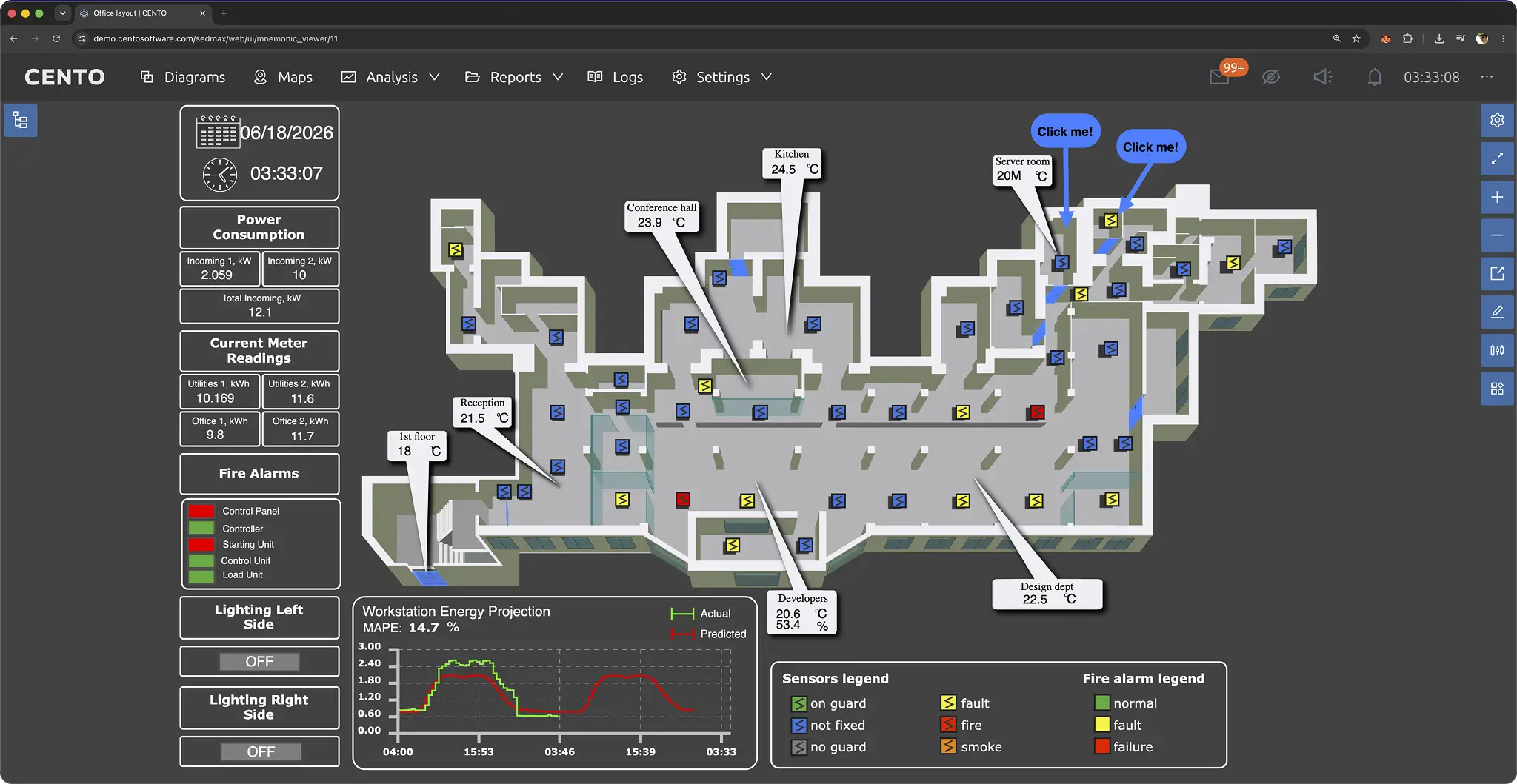
JSON in industrial automation matters because plant data rarely stays inside one system. Industrial teams often need to move operational data from SCADA, PLCs, meters, and historians into dashboards, APIs, reports, analytics tools, and digital twin models. JSON organizes this information into lightweight, readable key-value structures that software systems can exchange and interpret. It is useful for integration payloads, configuration data, event messages, and application-facing data exchange, but it is not a field communication protocol.
Why JSON matters in industrial environments
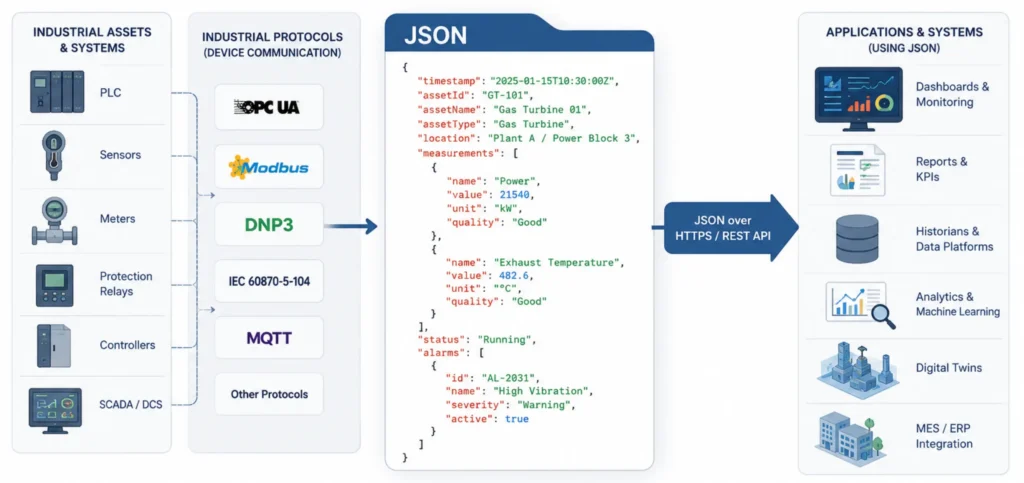
Industrial teams need more than raw sensor values to make fast decisions. A useful data object should include asset ID, timestamp, unit, status, source system, data quality, event type, and operating state. A structured format helps package this context when data moves across SCADA, PLCs, meters, historians, MES, ERP, and analytics tools. This structure reduces manual reconciliation between systems and gives engineers, operators, and managers a clearer basis for action. For engineering teams, JSON in industrial automation reduces the gap between raw device data and software-ready operational context.
How JSON works with APIs and industrial platforms
JSON for industrial APIs
APIs and web-based integrations commonly use JSON to exchange structured data between software systems. An industrial platform can expose selected plant data through API endpoints, such as current equipment status, energy consumption, alarm history, production KPIs, power quality events, or digital twin asset data. This gives enterprise systems a cleaner way to consume operational information without direct protocol-level integration. Instead of connecting business tools to PLCs or SCADA, APIs provide controlled, structured access to the data they need. This is where JSON in industrial automation becomes useful for connecting plant data with business applications safely.
Using structured data in a microservice architecture
Modern industrial platforms may use modular services for data acquisition, storage, visualization, alarms, analytics, and integration. JSON can move structured information between these services or expose it to external applications through APIs. This supports flexible industrial software design because each function can evolve without rebuilding the whole platform. However, JSON only helps with exchange. Scalable architecture still needs service discovery, security, data validation, monitoring, and reliable storage to keep industrial data usable and trustworthy.
Structured events, alarms, and operational context
Why events need structure
Industrial events are not just messages; they represent operational changes that can affect reliability, efficiency, or production flow. Examples include voltage sag, abnormal vibration, motor overload, communication loss, high demand peak, equipment trip, or manual override. Useful event data should include timestamp, asset, severity, source, duration, value, threshold, state, and affected process area. When events follow a structured format, teams can handle alarms more clearly and identify root causes faster.
How structured event payloads support industrial workflows
JSON can describe event payloads for journals, dashboards, notifications, analytics, and integrations. A structured event can show what happened, where it happened, when it happened, and which system reported it. This helps teams correlate equipment behavior, energy use, power quality disturbances, and process instability. However, event quality depends on accurate timestamps, reliable data quality, naming discipline, and consistent asset mapping. These details support operational intelligence and make predictive maintenance workflows more dependable.
Watch video about how CENTO works
Or read about what is CENTO and how it transforms enterprise operations into a unified digital twin, enabling energy consumption clarity, cost savings, sustainable growth and even more in our article.
Watch video about how CENTO works
Or read about what is CENTO and how it transforms enterprise operations into a unified digital twin, enabling energy consumption clarity, cost savings, sustainable growth and even more in our article.
JSON and digital twins
Why digital twins need structured asset data
A digital twin needs relationships, not only measurements. It must connect each sensor to an asset, each asset to a line, each meter to an area, each alarm to equipment, each event to a process state, and each asset to maintenance context. JSON can represent asset properties, configuration data, state updates, and integration payloads. However, JSON mainly supports exchange. The information model gives that data meaning inside the industrial system.
Time-series data and digital twin constraints
Industrial digital twins often depend on time-series data from sensors, meters, controllers, and production systems. This data needs timestamps, historical storage, aggregation, retention rules, metadata, asset references, and API filtering. JSON can expose time-series data through interfaces, but it is not enough for high-volume industrial histories. Platforms still need time-series databases, streaming, paging, aggregation, and query logic. In this role, JSON is a useful interface format, not the complete data infrastructure.
Where structured data fits alongside protocols and databases
Why software data formats do not replace industrial protocols
Software data formats serve a different purpose than OPC UA, Modbus, DNP3, or IEC standards. These protocols define how industrial devices, controllers, and automation systems communicate, including data access, events, security, or field-level exchange depending on the protocol. JSON serves a different role: it packages structured data for software applications, APIs, dashboards, analytics, and integrations. It should not be used to bypass control-system requirements or expose devices without proper architecture. The best design keeps device communication, supervision, analytics, and enterprise integration in the right layers.
JSON is not a database strategy by itself
JSON files or payloads are useful for exchanging structured information, but they are not enough for industrial-scale storage. Industrial platforms may need time-series databases for measurements and historical trends, relational databases for structured records, document stores for flexible data, graph databases for asset relationships, and event storage for alarms or incidents. JSON becomes more valuable when proper storage, indexing, validation, and governance keep the data searchable, reliable, and usable over time.
Clear next step: see how structured industrial data works in CENTO
JSON is most valuable when it is part of a complete industrial data architecture: protocols collect signals, CENTO contextualizes them, and structured data exchange makes them usable in dashboards, event journals, reports, APIs, analytics, and digital twin models. In a CENTO context, JSON in industrial automation supports structured exchange between field data, asset models, alarms, analytics, and external applications. To see this workflow in practice, explore the CENTO demo server or request a guided demo at info@centosoftware.com.
For related context, read more about CENTO as a unified industrial data platform, digital twin cross-system integration for SCADA, MES, and ERP, industrial data historian and real-time data storage, and enterprise-grade security for IIoT architecture.
Frequently asked questions
Q: What does JSON in industrial automation mean?
A: JSON in industrial automation means using JSON as a structured format to exchange information between industrial software systems. In automation, it can package sensor values, timestamps, asset IDs, units, alarm states, and data quality so dashboards, APIs, analytics tools, and digital twins can use the same operational context.
Q: Does JSON replace SCADA protocols such as OPC UA, Modbus, or DNP3?
A: No. JSON does not replace industrial protocols used by PLCs, meters, sensors, and SCADA systems. Protocols handle device communication, while JSON is mainly used above that layer to exchange structured data with applications, dashboards, reports, and enterprise systems.
Q: Why is JSON useful for industrial monitoring and analytics?
A: JSON helps industrial platforms move context-rich data into monitoring screens, reports, alerts, and analytics workflows. Instead of sending only raw values, JSON can include asset names, units, timestamps, operating states, and alarm details, which reduces manual reconciliation and improves decision-making.
Q: How does JSON support digital twins in industrial operations?
A: A digital twin needs relationships between assets, sensors, meters, alarms, events, and process states. JSON can exchange asset properties, configuration data, state updates, and event payloads, while the industrial information model gives those elements meaning inside the digital twin.
Q: When should an industrial company use JSON in automation projects?
A: JSON is useful when operational data must be exposed through APIs, integrated with MES or ERP systems, displayed in dashboards, or used by analytics and predictive maintenance tools. It is especially helpful when SCADA, historians, energy systems, and business applications need selected data without direct connection to control devices.
Q: What are the limitations of JSON for industrial time-series data?
A: JSON can expose time-series data through APIs, but it is not enough for high-volume industrial storage by itself. Industrial monitoring platforms still need time-series databases, aggregation, retention rules, streaming, paging, and query logic to handle sensor history, alarms, downtime analysis, and energy efficiency metrics.
Q: How can JSON help reduce downtime and improve maintenance decisions?
A: Structured JSON event payloads can describe alarms, equipment trips, abnormal vibration, communication loss, or power quality disturbances with timestamps, assets, severity, and affected process areas. This makes it easier to correlate events with equipment behavior, identify root causes, and support predictive maintenance decisions.
Q: How does CENTO use JSON in industrial data integration?
A: CENTO can use structured data exchange as part of a broader platform architecture that connects SCADA, sensors, meters, event journals, dashboards, analytics, and digital twin models. In this context, JSON helps expose selected operational data through software interfaces, while CENTO organizes the data around assets, events, and industrial context.