Most OT networks run on protocols that were never designed with security in mind. Modbus predates modern networking entirely. DNP3 was built for reliability, not authentication. The result is a protocol landscape where visibility and control exist, but the attack surface is rarely mapped.

Why do industrial protocol security gaps create operational risk?
OT equipment does not refresh on IT timescales. A production machine represents a significant capital investment and typically stays in service for 10–15 years or longer. The hardware and software embedded in that machine cannot easily be updated, which means the protocols it ships with are the protocols it runs for its entire operational life.
Legacy device: A device that cannot fulfill the security requirements of modern industrial networks, including devices running protocols such as Modbus that were designed without authentication or encryption.
Modbus arrived in 1979 for serial communication between PLCs and terminals. DNP3 followed in the early 1990s for power utility SCADA. Neither was designed with adversarial network conditions in mind — they were designed to work. IEC 61850 and OPC UA came later and added semantic structure and security capabilities, but even their adoption does not eliminate the installed base of older devices running older protocols alongside them.
In SCADA environments, the security priority ordering reflects that operational reality directly: availability ranks first, integrity second, confidentiality last. Encryption adds latency overhead that hinders real-time communication, so most SCADA traffic remains unencrypted. That makes it directly inspectable — a property that benefits network-based intrusion detection, but also means any attacker who reaches the network can read, replay, or modify what crosses it.
Security in brownfield retrofitting solutions has historically been treated as a secondary concern. Published surveys of middleware aggregation solutions confirm the pattern: the engineering priority is fast, reliable protocol translation. That gap between operational necessity and security posture is where most OT network vulnerabilities live.
How do DNP3, Modbus, OPC UA, and IEC 61850 actually work?
Each of these four protocols solves a different part of the industrial communication problem, and understanding the mechanism matters for understanding where the risk sits.
DNP3 is the primary Ethernet-based protocol used in modern smart grid SCADA for poll-and-response data exchange between substations and control centers. It supports unicast, multicast, anycast, and broadcast communication modes, which lets it handle distributed substation architectures with multiple data types — time-stamped values, priority data, and critical control commands. One of its defining features is the unsolicited response.
Unsolicited response: A DNP3 message in which an outstation sends data to the master without any prior polling request, triggered automatically when an unexpected change in system status occurs.
That capability matters operationally: an outstation does not need to wait to be asked. But it also means the master relies on receiving those messages — a fact that certain attack vectors exploit directly.
Modbus originated as a serial protocol (RTU and ASCII modes) and evolved into Modbus TCP, which is part of IEC 61158. Its simplicity and open specification made it the default choice for field device connectivity across nearly every industrial sector. The security-hardened variant, Modbus/TCP Security, was not introduced until 2018 and is defined only by the Modbus Organisation — it is not part of IEC 61158. Adoption of the secured variant remains limited precisely because of those long equipment lifespans.
On a practical level, multiple Modbus sensors can run on a single RS-485 bus simultaneously, each assigned a unique slave address. That simplicity is the protocol’s enduring advantage — and also why it persists in environments that would otherwise have moved on.
OPC UA (IEC 62541) was designed from the outset for secure, platform-independent industrial communication. It supports both client-server and publish-subscribe models. When used with an aggregating server architecture, it reduces the number of simultaneous connections that resource-constrained PLCs must manage to one per client — a meaningful benefit in environments where PLCs are also running real-time control tasks.
IEC 61850 has become the dominant standard for digital substation communication. Its object-oriented modeling approach and interoperable design set it apart from SCADA-era protocols. It carries three distinct communication services: GOOSE for fast event-driven control messages, Sampled Values (SV) for digitized current and voltage measurements from merging units, and MMS for configuration and data exchange over TCP/IP on the station bus. Each service has its own transport, its own timing requirements, and its own exposure profile.
What attack vectors target each protocol in the field?
Knowing that a protocol lacks authentication is different from knowing specifically how it gets exploited. The attack patterns vary by protocol architecture.
GOOSE (Generic Object-Oriented Substation Event): An event-driven, publisher-subscriber messaging service in IEC 61850 transmitted as Layer 2 Ethernet multicast frames with VLAN tagging for fast protection and control communication in digital substations.
GOOSE messages have no built-in security. Operating at Ethernet Layer 2, they lack the IP-level protections that MMS can leverage. Any attacker who gains LAN access can execute replay attacks, masquerade attacks, flooding denial-of-service, or packet-drop denial-of-service. IEC 61850 Sampled Values frames share the same exposure: transmitted as unencrypted Layer 2 multicast, they can be sniffed, injected, or replayed by anyone on the local network.
A man-in-the-middle attacker on the IEC 61850 process bus can inject falsified SV frames that trigger an unwanted relay trip by emulating a close-in three-phase short-circuit. Alternatively, a masquerading false data injection attack replaces fault-related samples with recorded normal values — preventing relay operation and allowing a real fault to persist undetected. These coordinated multi-parameter attacks, which preserve physical consistency between current and voltage values, are significantly harder to detect than the single-parameter perturbations studied in most prior research.
MMS, running over TCP/IP on the station bus, creates a different exposure. It provides access to configuration data and SCL content. If that data is modified, attackers can alter protection settings or logic parameters — a higher-privilege attack than simple traffic injection.
DNP3 attack vectors are more operationally targeted. A select-operate attack involves sniffing and replaying both the Select and Operate command payloads, potentially causing power outages at targeted substations. A broadcast request attack modifies the link-layer destination to the broadcast address, sending critical function codes to all stations simultaneously. A disable-unsolicited-response attack prevents the master from receiving spontaneous outstation updates — effectively blinding the control center to unexpected field events without triggering any obvious alarm.
For Modbus, the absence of any authentication mechanism means that any device that can reach the network segment can read registers, write coil values, or issue commands. There is no session, no credential, and no integrity check on the payload.
Watch video about how CENTO works
Or read about what is CENTO and how it transforms enterprise operations into a unified digital twin, enabling energy consumption clarity, cost savings, sustainable growth and even more in our article.
Watch video about how CENTO works
Or read about what is CENTO and how it transforms enterprise operations into a unified digital twin, enabling energy consumption clarity, cost savings, sustainable growth and even more in our article.
What do the numbers say about protocol performance and security overhead?
The argument against adding security to latency-sensitive OT protocols is usually framed around overhead. The measured data is more nuanced.
For IEC 61850 GOOSE, the type 1A delivery requirement is 3 ms. IEC 62351 MAC verification using AES-GMAC-128 adds an average processing latency of 0.38 ms, with a maximum of 0.64 ms — well within budget. A semantics-enforced rule-based IDS adds 0.25 ms average, 0.40 ms maximum. The hybrid approach combining both layers adds 0.54 ms average, 0.88 ms maximum. All three remain inside the 3 ms constraint. These measurements were taken on a modest processor with 4 GB RAM and no CPU-level optimizations, suggesting they represent a conservative upper bound for deployable hardware.
Flooding attacks on GOOSE typically operate at rates far exceeding normal steady-state intervals — tested scenarios reached approximately 1000 Hz, while normal GOOSE traffic runs below 100 Hz. That gap is what time-threshold IDS rules exploit for detection.
For OPC UA, the performance profile depends heavily on what operation is being performed. Single-node reads run at a 3.0 ms median. Variable enumeration — which requires recursive tree traversal — has a median of 103.9 ms and a p95 of 108.2 ms. Two orders of magnitude difference. Parallel cross-protocol tool calls reduce latency from 7.1–7.4 ms (sequential) to 3.7–3.8 ms, confirming that concurrent invocation works correctly for multi-protocol environments.
Brownfield system: An existing industrial installation containing legacy devices that cannot easily be updated to support modern security standards, typically placed in isolated security zones to contain risk.
Modbus and similar polling-based adapters operate in the low single-digit millisecond range — p95 under 3.3 ms — making them viable for latency-sensitive polling workflows even when wrapped in an aggregation layer. The OPC UA SigmaServer aggregation proxy achieves end-to-end latency below 2.6 ms with internal processing averaging 21.15 µs, while consuming only 6–19 MiB of RAM versus 105–115 MiB for the OPC Foundation reference aggregation server. CPU usage stays between 0.75% and 3.16%. That resource profile fits constrained OT hardware.
How to start securing legacy protocol deployments
Given that replacing legacy devices is often not an option, the practical path runs through architecture rather than hardware replacement.
The foundational approach is zone and conduit segmentation following IEC 62443. Legacy devices are placed in isolated security zones. A conduit — implemented as a firewall or one-way gateway — controls what data crosses zone boundaries. This contains the blast radius if a legacy protocol is exploited without requiring the device itself to be updated.
Conduit: A controlled connection between network zones, typically implemented as a firewall or one-way gateway, restricting unauthorized traffic between zones with different security requirements.
Using MACsec at ISO/OSI Layer 2 can secure Ethernet-based industrial protocols. However, it does not address the continued use of insecure legacy protocols within the network — it only protects the transport layer. The insecure protocol continues operating inside the segment.
For IDS deployment against DNP3 traffic, rule placement matters measurably. Rules positioned earlier in the IDS repository have lower processing and detection times. High-impact rules should be prioritized first. Rule complexity also directly increases latency — rules with many option fields take longer to evaluate. For distributed deployments, this was validated at a real power utility where a rule set was pushed from the master node to substation client nodes over a ring fiber link.
On the IEC 61850 side, IEC 62351-6:2020 explicitly recommends integrating rule-based semantic checks with MAC verification for GOOSE defense. Neither technique alone covers the full attack surface. MAC verification alone fails against replay attacks, because a replayed packet retains a valid MAC tag computed from the original unchanged PDU. Rule-based IDS alone fails against masquerade attacks when the crafted packet uses valid incremented sequence numbers. Only the hybrid approach handles both — and even then, packet-drop DoS requires additional mechanisms such as SDN-based traffic control or PRP/HSR redundancy.
How do these protocols connect at the system level in a modern OT architecture?
In practice, none of these protocols operates in isolation. A typical modern OT installation runs several simultaneously at different layers of the stack, and the architectural question is how to manage the boundaries between them.
At the substation level, IEC 61850 creates a clear internal hierarchy: the process bus carries time-critical GOOSE and SV traffic as Layer 2 multicast; the station bus carries MMS over TCP/IP connecting IEDs to SCADA and engineering workstations. These are logically — sometimes physically — separate segments. VLANs provide only logical separation, and misconfiguration or VLAN hopping can expose both streams to adversaries nominally outside the segment.
Correlating cyber data from GOOSE (circuit breaker trip signals) with physical data from SV (voltage values) simultaneously improves anomaly detection. A voltage fault present without a corresponding CB trip signal is an anomaly indicator — it cannot arise from a genuine physical fault. That cross-verification logic requires unified access to both data streams, which is exactly what a system-level integration layer enables.
SCL (System Configuration Language): The XML-based descriptive language defined by IEC 61850 for configuring electrical power utility systems, with file types including SSD, ICD, SED, and SCD serving different configuration purposes.
SCL files encode the full substation topology — device IP addresses, port connectivity, IED capabilities — in machine-parseable XML. That makes them a natural starting point for automated configuration of monitoring and integration tooling. They are also a target: MMS access to SCL content, if exploited, can allow alteration of protection settings across the substation.
The hybrid MAC plus IDS approach is the only tested method that detects and mitigates both replay and masquerade attacks simultaneously. No tested technique covers packet-drop DoS — only detection is achievable, requiring supplementary SDN-based traffic control or redundancy protocols. After cyberattack detection, SDN switches can isolate compromised IEDs and activate standby devices that restore normal circuit breaker operation within 3 cycles — but that response depends on having the detection infrastructure in place first.
For environments that span Modbus at the field level, DNP3 at the SCADA communication layer, OPC UA for enterprise integration, and IEC 61850 in the substation — a unified protocol-aware integration layer is the practical requirement. Modern open frameworks already cover this combination natively alongside additional protocols including EtherCAT, EtherNet/IP, PROFIBUS, PROFINET, BACnet/IP, and Siemens S7comm, confirming that multi-protocol coexistence is the norm rather than the exception in real deployments.
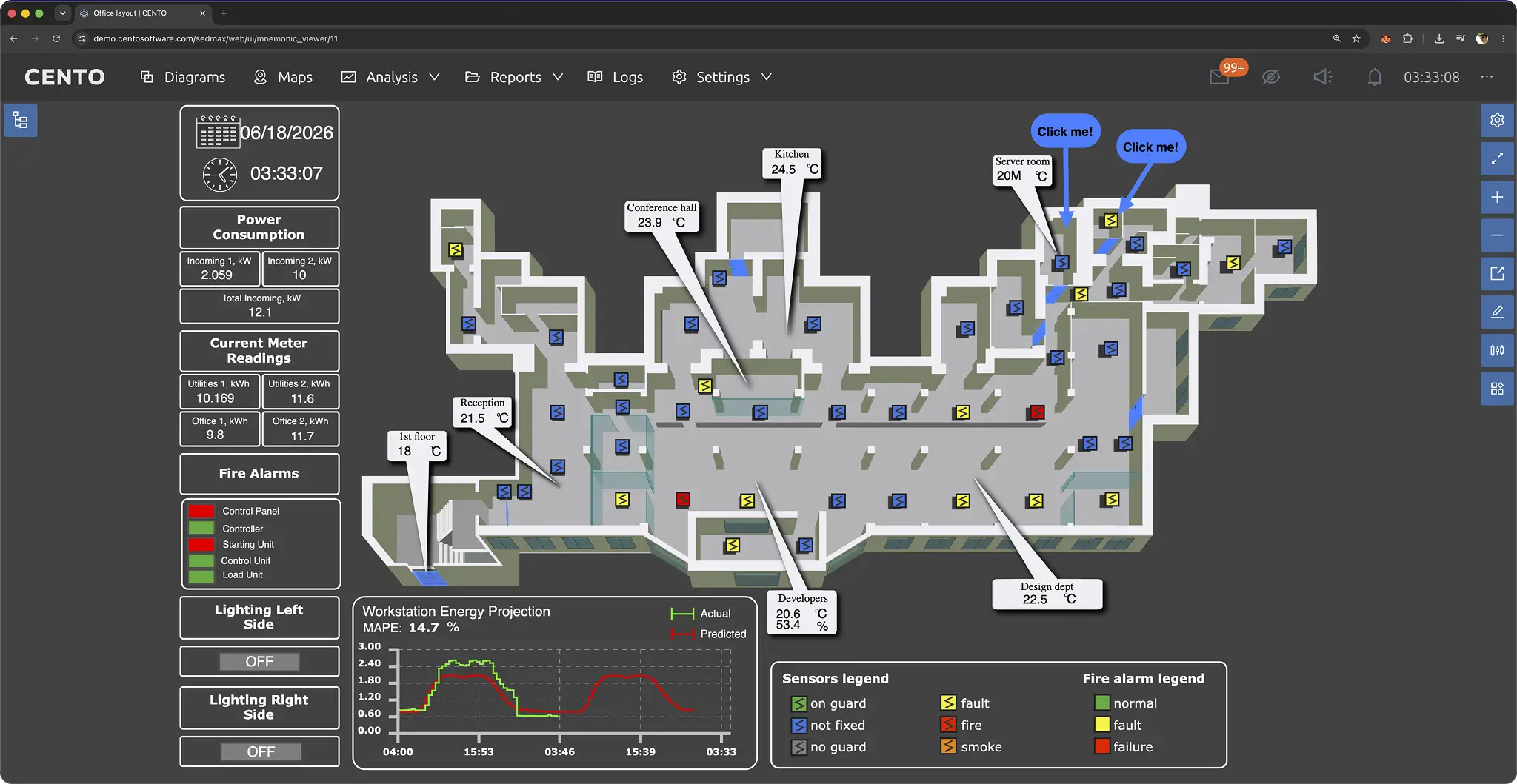
CENTO connects to this multi-protocol environment at the data layer, normalizing what comes from SCADA, PLCs, historians, and field devices into a unified operational model — without requiring the underlying protocols to be replaced or re-architected.
Clear next steps you can take with CENTO
The first step is connecting the data sources already present in your environment — SCADA systems, PLCs, field historians, Modbus devices, and OPC UA endpoints. CENTO’s system integration layer handles this without replacing existing infrastructure, bridging legacy protocols and modern endpoints into a single normalized data stream. No protocol replacement required.
Once data sources are unified, CENTO establishes a baseline across the operational environment. What is normal traffic volume on a given segment? What are the typical polling intervals? What events correlate across layers? Without that baseline, distinguishing anomalous behavior from operational variation is guesswork. The CENTO platform builds that context automatically from real operating data, linking machine states, production orders, and communication events into a unified operational model.
From the baseline, the next step is identifying where the largest sources of avoidable risk or inefficiency actually sit. In protocol-mixed environments, this often means finding segments where legacy devices are directly reachable from higher network layers, or where events at the field level are not correlated with higher-level operational data. CENTO makes those gaps visible by adding operational context to raw device data — connecting what a sensor reports to what the system was actually doing at the time.
Prioritizing improvements starts with what is actionable without large capital investment. Zone segmentation, IDS rule ordering, and aggregation architecture changes are operational decisions, not hardware replacements. CENTO surfaces the data needed to make those decisions against real operating conditions rather than theoretical architecture diagrams. Metering and reporting capabilities extend this further — maintaining the historical operational record that makes before-and-after comparison meaningful, whether the change was a network segmentation update, a new IDS rule set, or an equipment configuration adjustment.
To explore the platform or get a guided walkthrough of how CENTO connects to your specific protocol environment, contact the team directly.