Industrial environments have never lacked data. The real problem is moving it from sensors and PLCs through SCADA systems, historians, and MES platforms into the analytics layer where decisions get made. OPC UA solves that problem at its root. It defines how data travels, how it gets described, and how it stays secure across every layer of the industrial architecture.
What OPC UA is and how it works
Before the standard existed, connecting industrial devices to software meant building custom integrations for every vendor and every platform. That infrastructure was functional in isolation, costly to maintain, and impossible to scale. The OPC Foundation designed the protocol to remove that constraint. It gives devices and applications a shared communication framework that works regardless of hardware vendor or operating system.
How OPC UA is structured as an industrial standard
OPC UA (Open Platform Communications Unified Architecture) is an open, platform-independent communication standard for industrial systems, formalized under IEC 62541. The OPC Foundation released it in 2008 as the successor to OPC Classic, which was tied to Windows through Microsoft’s DCOM technology. In contrast, this standard runs on Linux, embedded controllers, cloud environments, and everything in between. It supports vertical integration across the automation pyramid and horizontal communication between peer systems. As a result, it applies from field-level sensors all the way up to enterprise ERP systems.
An information model built for Industry 4.0
What separates this standard from simpler industrial protocols is how it represents data. Every OPC UA server exposes an address space — a structured graph of nodes. Each node describes not just raw values, but objects, methods, relationships, and metadata. This structure is precisely what the Industry 4.0 Asset Administration Shell relies on for interoperability between industrial applications. Research on AAS-to-OPC UA mapping confirms that the node-based address space carries semantic meaning across systems, not just tag values. Additionally, industry-specific companion specifications extend the model for sectors like packaging, energy, and robotics.
What problems OPC UA solves in practice
Industrial facilities run on heterogeneous systems. A typical plant has PLCs from three different vendors, a SCADA platform from a fourth, and an MES integrated by hand a decade ago. Each connection is a potential failure point. When a firmware update breaks a proprietary driver, production data disappears from dashboards. Engineers then spend hours diagnosing connectivity instead of process behavior. That kind of reactive work is expensive and entirely avoidable.
Eliminating driver sprawl and integration debt
The standard replaces tangled proprietary interfaces with a single, standardized connectivity layer. Software applications connect through a common client-server model. The server exposes device data; clients subscribe to what they need. Therefore, teams no longer maintain separate drivers for each device type. Peer-reviewed research documents this architecture as the backbone of IT/OT convergence. It enables SCADA systems, HMIs, and ERP platforms to access field data through one consistent interface. The practical results are clear: fewer integration failures, lower maintenance overhead, and faster onboarding of new equipment.
How OPC UA supports real-time data pipelines and cloud connectivity
For large-scale or multi-site deployments, the specification also defines a publish-subscribe model in Part 14. Instead of maintaining individual client-server sessions, publishers send data to a message broker over MQTT or AMQP. Subscribers then consume it independently. This decoupled approach scales well across distributed systems. Moreover, it makes the protocol a practical transport layer for industrial IoT and cloud analytics platforms. Research from engineers confirms that matching industrial traffic types to the right PubSub configuration is critical for meeting real-time constraints without degrading network performance.
Publish-subscribe model — a pattern where producers publish updates to a shared broker and consumers subscribe independently, enabling scalable distribution without point-to-point connections.
Watch video about how CENTO works
Or read about what is CENTO and how it transforms enterprise operations into a unified digital twin, enabling energy consumption clarity, cost savings, sustainable growth and even more in our article.
Watch video about how CENTO works
Or read about what is CENTO and how it transforms enterprise operations into a unified digital twin, enabling energy consumption clarity, cost savings, sustainable growth and even more in our article.
How OPC UA compares with other industrial protocols
The standard does not replace everything. Modbus, DNP3, PROFIBUS, and other field protocols remain embedded in operational infrastructure. Most engineers don’t ask whether to use this standard — they ask where it fits and where it doesn’t. Getting that boundary right determines whether an integration project succeeds or adds new complexity.
Where OPC UA outperforms legacy protocols
Legacy protocols like Modbus deliver deterministic, low-latency communication between specific device types. However, they carry no semantic context, enforce no security, and don’t connect to IT systems. The standard addresses all three gaps. Its built-in security model uses X.509 certificate authentication, encrypted sessions, and role-based access control. As a result, data travels securely from the plant floor to a cloud analytics platform without a separate security layer. Peer-reviewed performance analyses confirm the protocol runs reliably across constrained edge devices and enterprise management systems alike.
When OPC UA works alongside existing protocols, not instead of them
In most deployments, the standard acts as a translation and aggregation layer rather than a field protocol replacement. A gateway or edge server runs an OPC UA server. That server connects to downstream Modbus, PROFINET, or EtherNet/IP devices, normalizes their data into the information model, and exposes a unified interface upward. Consequently, existing infrastructure stays in place while teams enable modern analytics, digital twin synchronization, and MES integration. The companion specification ecosystem accelerates this further. It covers dozens of industry domains through pre-built information models that encode domain-specific semantics directly into the data structure.
How organizations start working with OPC UA and where CENTO fits
The gap between understanding the standard and operationalizing it is where most projects stall. The specification covers fourteen parts, companion specifications for individual industries, two communication models, and a security framework that needs careful configuration. Organizations that treat implementation as a connectivity project tend to underutilize it. Those that treat it as a data architecture decision get far more value.
Using OPC UA as the foundation for operational intelligence
Research on Unified Namespace architectures shows how the standard abstracts device-specific protocols into a single communication layer. This connects legacy OT systems and modern IIoT devices to the same data environment. In a documented six-month deployment at a mid-sized electromechanical plant, continuous data from motors, variable speed drives, CNC machines, and robotic systems flowed through this architecture. Machine learning models then used that data to predict temporal degradation and support maintenance decisions. That kind of outcome requires a structured, semantically consistent data layer — which is exactly what this standard provides. CENTO uses the same foundation to synchronize asset state in real time and enable predictive maintenance workflows without custom pipelines for each data source.
Integration with SCADA, MES, and ERP through a common OPC UA data layer
One of the most immediate benefits is how the protocol simplifies vertical integration. Field data that previously stopped at the SCADA layer — or needed a custom connector to reach the MES — becomes accessible through the subscription mechanism. The MES or ERP system acts as a client. It monitors specific tags and receives updates only when values cross defined thresholds. This eliminates constant polling and reduces network load. Furthermore, business-layer systems gain access to machine data that previously required manual extraction. A systematic review of ML and OPC UA integration found that hybrid architectures combining the standard with machine learning are increasingly common in predictive maintenance and quality control. CENTO connects to existing SCADA, historian, and MES environments this way. No rearchitecting of the plant floor is required.
Clear next step: see how structured industrial data works in CENTO
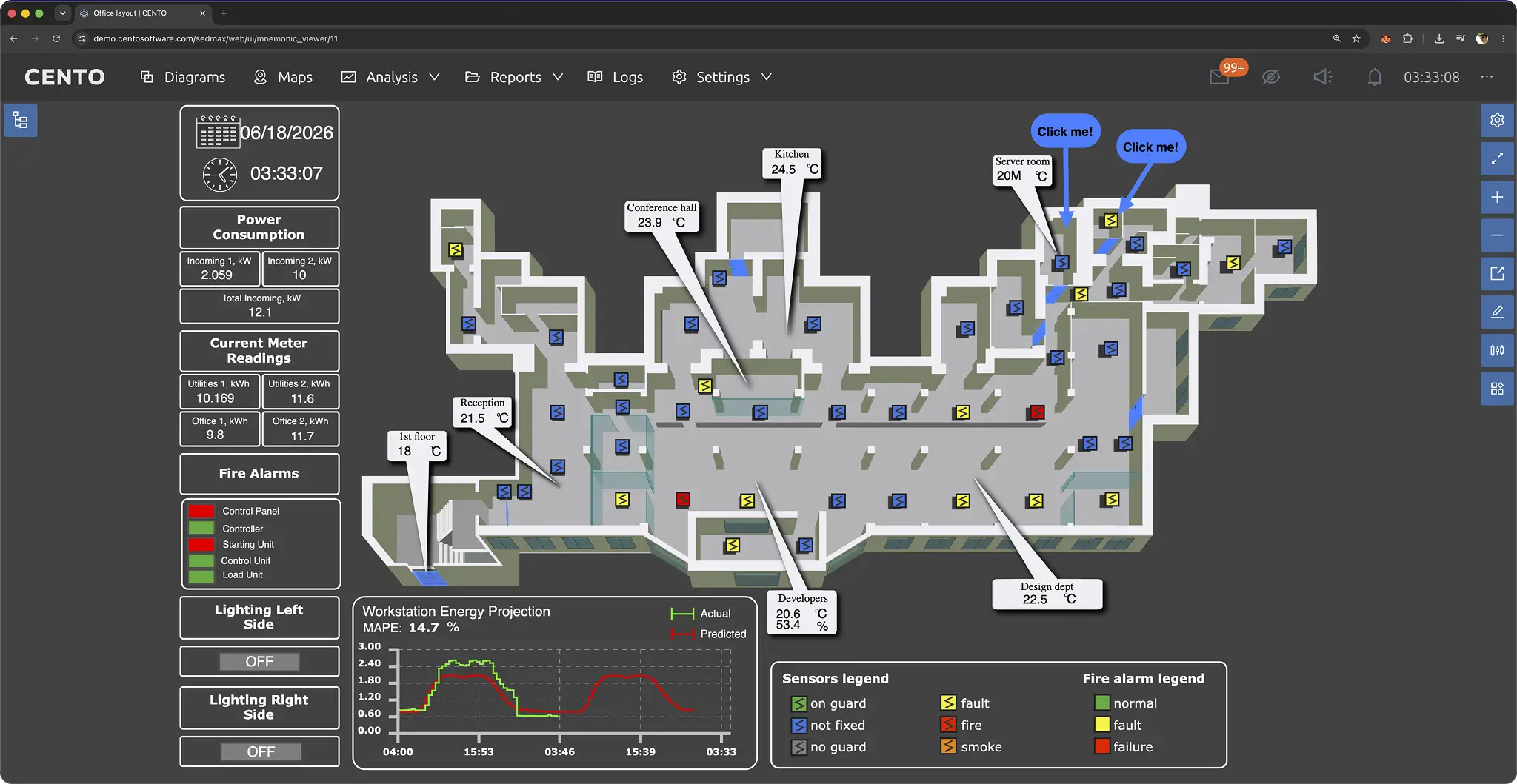
OPC UA is most valuable when it becomes part of a complete industrial data architecture. Field protocols and devices expose operational signals, CENTO connects to OPC UA servers, and the unified information model turns equipment data into context for dashboards, event journals, reports, APIs, analytics, and digital twin workflows.
In a CENTO environment, OPC UA helps move structured, secure, and vendor-independent data from PLCs, SCADA systems, historians, and edge gateways into the operational intelligence layer.
To see this workflow in practice, explore the CENTO demo server or request a guided demo at info@centosoftware.com.
For related context, read more about CENTO as a unified industrial data platform, digital twin cross-system integration for SCADA, MES, and ERP, industrial data historian and real-time data storage, and enterprise-grade security for IIoT architecture.