Energy optimization systems fail not because the models are wrong, but because they operate on data that is already stale, partial, or contradicted by another system. When SCADA, ERP, and optimization engines each maintain separate versions of plant reality, the gap between the optimal plan and actual operations widens every hour. Closing that gap requires integration that goes deeper than data piping.

Why does energy optimization fail without deep integration into SCADA, ERP, and industrial data platforms?
Most energy optimization deployments start with a model. The model is calibrated, validated, and handed to the operations team with a scheduling recommendation. Within days, the recommendations drift from what actually happens on the floor. Production loads shift. A chiller trips. Fuel prices change mid-week. The plan looks reasonable on paper — but the physical plant is running a different schedule entirely.
The root cause is rarely the optimization algorithm. Fixed scheduling approaches that rely on 24-hour day-ahead windows tend to produce excessive charge/discharge cycles and over-discharge storage assets at the end of each window, degrading real-world performance compared to what the model predicted. The model saw a clean dataset. The plant operates in continuous flux.
Integrated Energy System (IES): A multi-energy system combining electricity and thermal energy generation, conversion, and storage — including wind, solar, CHP, and electric boilers — to flexibly meet both electrical and thermal demands across different time and spatial scales.
Without live SCADA telemetry feeding the optimization engine, and without ERP cost structures informing dispatch decisions, the system optimizes against a static snapshot. In multi-energy environments where thermal demand alone accounts for 80–90% of winter energy consumption, a stale snapshot is not a minor inconvenience — it is the difference between genuine cost reduction and an expensive modeling exercise.
The integration problem is structural. SCADA systems are designed for availability and real-time control. ERP systems are designed for financial record-keeping and procurement. Optimization engines are designed for mathematical scheduling. None of these systems was built to serve the others. Making them work together requires deliberate architecture, not middleware.
What does tightly integrated energy optimization actually look like at the system level?
In a well-integrated deployment, the optimization engine does not run on a fixed daily cycle. It operates as a continuous loop: pulling telemetry from SCADA, reading tariff and cost structures from ERP, updating its internal model of plant state, and issuing revised dispatch instructions. The loop closes on observed outcomes, not on forecasts.
Revenue from energy flexibility compounds across multiple uses. Grid-connected storage assets that participate in a single market — peak shaving alone, for example — rarely recover investment costs within acceptable payback periods. Allocating capacity across arbitrage, frequency regulation, peak shaving, and demand response services simultaneously reduces payback periods substantially.
Revenue Stacking: A business model that optimizes battery capacity by allocating it across multiple uses and market applications simultaneously — such as arbitrage, frequency regulation, peak shaving, and energy community services — to improve financial viability.
At the control layer, piecewise linear relaxation of nonlinear storage charging curves eliminates the computational intractability that prevents real-time re-optimization, while preserving the power-dependent efficiency behavior that matters for accurate dispatch. This is the mechanism that makes continuous-loop optimization tractable rather than a once-daily batch job.
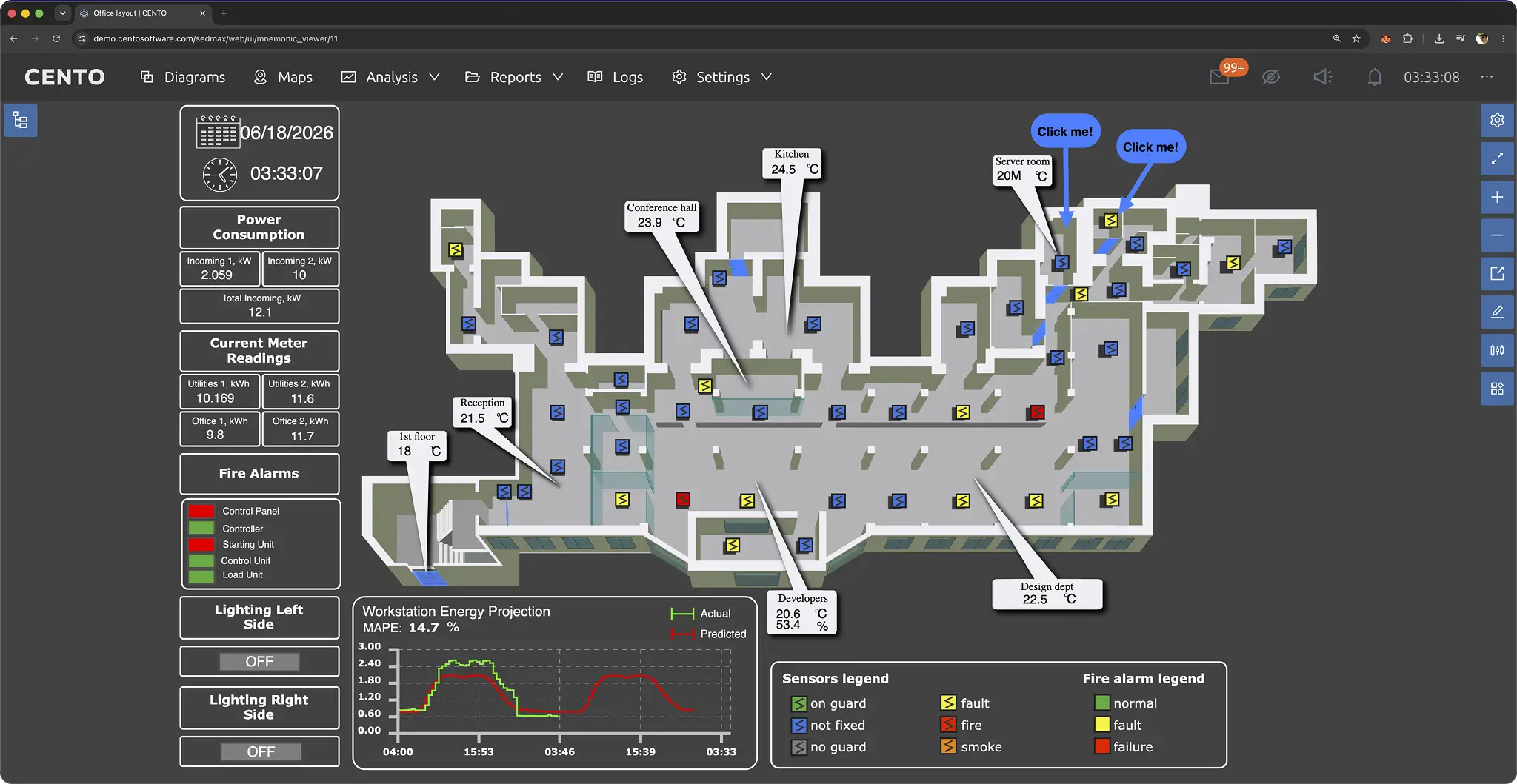
CENTO connects to existing SCADA infrastructure via OPC-UA, Modbus, and REST interfaces, pulling raw telemetry into a unified operational data model without requiring changes to the control layer. The optimization engine works against that unified model — not against isolated historian exports or manually staged spreadsheets.
KKT optimality conditions can convert a nonlinear bi-level leader-follower dispatch problem into a single-level MILP, making large-scale multi-energy optimization tractable within the time constraints of operational scheduling. This is the class of formulation that enables energy providers and consumers to reach a stable pricing equilibrium automatically, rather than through manual negotiation.
How do real-time data flows between SCADA and optimization engines reduce operational cost?
The performance gap between fixed-schedule and adaptive optimization is measurable. A prediction-free two-stage coordinated optimization framework, applied to a microgrid with hybrid hydrogen and battery storage, reduced operational costs by 40–57% and loss of load by 60–90% compared to standard online optimization baselines. Against prediction-dependent model predictive control specifically, the same approach reduced operational costs by a further 24–29% and loss of load by 73–89%.
Those numbers reflect the cost of forecast dependency. When an optimization engine relies on a demand or generation forecast that proves wrong — a common occurrence in industrial facilities with variable production schedules — dispatch decisions made six hours ago remain in force even after the forecast has failed. Real-time SCADA data breaks that dependency by giving the optimization layer a continuous view of actual plant state rather than a projection of expected state.
Thermal Energy Storage (TES): A system that charges ice storage during off-peak hours at night and provides cooling during peak hours during the day; the ice storage tank acts as a thermal battery to shift loads from the day to the night.
In a commercial building deployment in Beijing, an integrated ice-based TES prediction-and-control system achieved a 9.9% energy cost saving rate after being deployed directly within the building automation system. The result was achieved not by replacing the control infrastructure, but by connecting prediction models to the existing BAS data layer and updating control decisions intraday at five defined correction points. In a district heating context, optimal multi-source design — integrating gas boiler, heat pump, solar thermal, and TES — can converge to a levelized cost of heat of 68.73 €/MWh when the optimization model is supplied with accurate, real-time performance data rather than fixed a priori coefficients.
The mechanism is straightforward: every hour that the optimization engine receives accurate state data from SCADA, it can correct for drift between the plan and reality. Every hour it cannot, that drift compounds.
Watch video about how CENTO works
Or read about what is CENTO and how it transforms enterprise operations into a unified digital twin, enabling energy consumption clarity, cost savings, sustainable growth and even more in our article.
Watch video about how CENTO works
Or read about what is CENTO and how it transforms enterprise operations into a unified digital twin, enabling energy consumption clarity, cost savings, sustainable growth and even more in our article.
Where does ERP integration unlock energy cost reduction across industrial deployments?
ERP systems hold information that optimization engines need but rarely receive: real-time tariff structures, procurement costs, production order schedules, and cost center allocations. Without ERP integration, an optimization engine may dispatch storage assets during periods when the actual blended energy cost — including demand charges, capacity fees, and commodity rates — makes that dispatch economically counterproductive.
Time-of-use tariff structures illustrate the point precisely. In commercial buildings operating under TOU pricing, daytime peak rates can reach approximately ten times the nighttime off-peak rate. An optimization engine that does not read current tariff data from the ERP cannot exploit that differential reliably — it is guessing at the economic boundary conditions it is supposed to optimize against.
Time-of-Use (TOU) Tariff: A fixed pricing scheme that applies lower electricity prices during the night and higher prices during the day, according to the balance of supply and demand in the power grids.
Demand response with differentiated strategies across building or production zone types — distinguishing thermal load flexibility in public areas from that in residential or manufacturing zones — consistently delivers the lowest user energy costs among tested operational modes. The differentiation is only possible when the optimization engine has access to cost allocation data that originates in the ERP, not in the SCADA layer.
At a system level, the Stackelberg game model demonstrates that energy providers and consumers can reach a Nash equilibrium that reduces user energy costs while maintaining provider profitability — but only when real-time pricing signals, which the ERP controls, flow directly into the dispatch optimization rather than arriving as a daily price file delivered hours after the fact.
Real-time pricing-driven load shifting reduces peak electrical loads during high-cost windows and shifts demand toward periods of high renewable output, reducing wind curtailment. The ERP provides the tariff signal; SCADA provides the confirmation that the load actually shifted. Neither alone closes the loop.
How to secure the data pipeline between energy optimization systems and industrial platforms
SCADA environments present a security architecture that differs fundamentally from IT systems, and that difference shapes how integration must be designed. In SCADA, availability is the highest-priority security property — all processes operate in real time, and a communication delay that would be inconsequential in an ERP context can cause a physical control failure. Integrity ranks second. Confidentiality, which dominates IT security thinking, ranks lowest.
This priority order has a direct consequence for data pipelines: most SCADA environments do not encrypt communications, because encryption overhead creates latency that threatens availability of critical control messages. Any integration architecture that adds encryption to the SCADA communication layer without accounting for that latency budget will degrade the control system it is meant to augment.
Distributed IDS (D-IDS): An intrusion detection architecture comprising a master node and multiple forward sensor nodes at geographically distributed substations, enabling centralized monitoring and detection of anomalies across an entire SCADA network from a single standpoint.
The practical response is to place security enforcement at the boundary between the SCADA network and the data integration layer, rather than inside the SCADA network itself. A distributed IDS architecture — with a master node coordinating sensor nodes at substations, each operating in promiscuous mode — can monitor SCADA traffic for anomalies without adding latency to control-layer communications. IDS rules with higher impact should be placed at the top of the rule repository, since processing time is directly affected by rule order and complexity.
For the ERP integration path, encryption overhead is less constrained. AES-256 at rest combined with TLS 1.3 in transit reduces exposure windows substantially compared to unprotected data transfer, and the latency cost is acceptable given the non-real-time nature of ERP data flows. The two pipelines — SCADA to optimization, and ERP to optimization — require different security architectures applied at different points in the data flow.
How to connect optimization models, SCADA telemetry, and ERP cost data into a single control loop
Building a single control loop from three systems with different update frequencies, data formats, and security requirements is an integration engineering problem as much as an algorithmic one. The optimization layer needs SCADA telemetry at sub-minute resolution to track plant state accurately. It needs ERP cost data at tariff-period resolution — typically hourly or sub-hourly — to make economically correct dispatch decisions. And it needs to write dispatch instructions back to the SCADA control layer without bypassing the safety and availability guarantees that SCADA was designed to enforce.
The offline and online stages of the optimization must be separated. In the offline stage, historical SCADA data and AI-generated scenario augmentation are used to produce state-of-charge reference trajectories for storage assets. Online Gaussian kernel regression — weighting historical scenarios by similarity to current observed conditions — updates those references in real time as observed plant state diverges from the offline reference. This structure means the online optimizer never needs a forecast; it tracks a reference that was already validated against realistic operating scenarios.
Intraday correction is the mechanism that makes this practical. A mid-day modification run at defined intraday intervals — using observed recent loads to update predictions and re-optimize remaining dispatch decisions — consistently outperforms fixed day-ahead scheduling, even when the underlying prediction model has non-trivial error. The corrections happen within the existing SCADA and BAS data infrastructure; no new sensors are required.
The MILP formulations that underpin these optimization loops have been validated in production environments using standard solvers integrated with existing plant data systems. The computational path from SCADA telemetry to revised dispatch instruction is tractable within operational time windows when the model structure is correctly decomposed — separating storage reference generation from real-time dispatch, and separating thermal load optimization from electrical dispatch.
CENTO’s data contextualization layer bridges the format and timing gaps between SCADA historians, ERP cost tables, and optimization model inputs, so that the control loop operates on a consistent, timestamped representation of plant state rather than on ad hoc data extracts. That consistency is what allows the optimization models to perform in production the way they perform in validation.
Clear next steps you can take with CENTO
The first step is connecting the data sources you already have. SCADA systems, PLCs, historians, and energy meters contain the telemetry the optimization layer needs, but that data is rarely in a format the optimization model can consume directly. CENTO connects legacy and modern industrial systems into a unified data flow, helping operational teams work with device-level readings, process data, and enterprise context in one environment. See how CENTO system integration supports SCADA, MES, ERP, energy meters, controllers, and legacy systems.
Once SCADA and historian data are unified, CENTO establishes a baseline. What does actual energy consumption look like against production volume, time of day, and equipment state? Where do SCADA logs and ERP cost allocations contradict each other? The CENTO unified data platform helps bring operational, technical, and business data into one consistent data space, so engineers, energy managers, and operations managers work from the same numbers instead of separate system exports.
With a baseline in place, the next step is identifying the largest sources of avoidable loss. Fixed-schedule storage dispatch, over-reliance on peak-rate electricity during predictable load windows, and thermal systems running at full capacity during low-demand periods are among the first patterns to appear. The CENTO Energy Balance module provides the granular visibility needed to understand how energy is produced, consumed, distributed, and lost across the site before any optimization model is deployed.
The easiest improvements to implement are usually operational, not capital: adjusting dispatch timing to align with TOU tariff windows, correcting load-shifting schedules that were built on stale day-ahead forecasts, and ensuring that thermal storage assets are being used against real consumption data rather than fixed seasonal schedules. CENTO surfaces these opportunities directly from existing data, without requiring a new sensor program or a separate analytics platform.
Tracking results requires connecting optimization outcomes back to actual operating conditions, not to model predictions. CENTO links dispatch decisions to the SCADA telemetry and ERP cost records that confirm what actually happened, so performance is measured against real operations. For broader context on how SCADA, MES, and ERP data can be connected into a consistent industrial reporting layer, read more about digital twin cross-system integration for SCADA, MES, and ERP.
To explore the platform in a live environment, visit the CENTO demo environment. For a guided walkthrough of integration options for your specific SCADA and ERP configuration, contact the CENTO team.