Industrial teams rarely question a legacy SCADA system because it has stopped working. They question it because keeping it reliable has become harder to prove. A server depends on an unsupported operating system. Only one engineer understands a critical script. Replacement hardware is scarce. Alarm behavior differs between sites, backups have never been restored under test conditions, and a small interface change can require a plant-wide maintenance window.
Those conditions create pressure to replace the platform, but replacement is not the only valid response. A stable control layer may still have years of useful life. Some facilities need better browser access, consolidated data, and a supported historian rather than a complete control-system rebuild. Others have accumulated security, recovery, integration, and knowledge risks that cannot be contained through another extension. The right decision depends on operational evidence, not the installation date alone.
SCADA modernization is therefore a governed change program. It can retain, extend, upgrade, or replace components while preserving defined requirements for safety, reliability, performance, and control authority. The work begins with an inventory and risk baseline, moves through architecture and migration decisions, and ends only when testing, rollback readiness, training, and operational acceptance are complete.
Why SCADA modernization starts with operational risk, not software age
Age is a warning signal, not a replacement rule
An old system can remain dependable when its configuration is documented, replacement parts are available, backups are tested, and qualified people can maintain it. A newer platform can present more risk if its integrations are opaque, access is poorly governed, or restore procedures exist only on paper. Research on industrial legacy modernization supports this distinction: legacy status is shaped by business continuity, operational stability, and risk, not technical age alone.[1]
A useful assessment asks what the system must continue to do and what could prevent it from doing so. That includes process visibility, command paths, alarm handling, historical records, reporting, user access, time synchronization, communications, and recovery. It also includes organizational dependencies such as specialist knowledge, support contracts, source files, and change approval.
Look for evidence of concentrated risk
Modernization becomes more urgent when several weaknesses reinforce each other. Unsupported software is more serious when the team also lacks a tested image and compatible replacement hardware. An undocumented PLC interface is more serious when production reporting and quality records depend on it. Remote access is more serious when identity, logging, and network boundaries are unclear.
The assessment should group findings into operational continuity, supportability, cybersecurity, maintainability, interoperability, data continuity, and workforce capability. Each finding needs an owner, evidence, consequence, and treatment. A red score should mean something specific, such as an untested recovery path for a critical node, not simply “old technology.”
Keep safety and control authority explicit
OT guidance stresses that security changes must account for performance, reliability, and safety requirements.[2] The same principle applies to modernization as a whole. A new interface cannot be judged only by visual quality, and a new protocol cannot be judged only by connectivity. Teams must know which functions observe the process, which functions issue commands, and who has authority to approve a change in each operating state.
This boundary protects the project from a common mistake: treating supervisory convenience as permission to change deterministic or safety-related control. Those changes require the applicable engineering, hazard review, validation, and management-of-change process. A content framework or product selection exercise cannot replace them.
Choose whether to retain, extend, upgrade, or replace
Retain when the risk is controlled and recovery is proven
Retaining the current platform can be reasonable when it meets operational needs, support remains viable, and the organization can demonstrate recovery. The decision should have conditions. Examples include maintaining spare hardware, testing backups, controlling remote access, preserving engineering files, monitoring support dates, and setting a trigger for reassessment.
“Do nothing” is not a retain strategy. Retention still has cost and work: vulnerability treatment, documentation, training, restoration exercises, and lifecycle monitoring. These activities belong in the baseline against which other options are compared.
Extend or upgrade when the control foundation remains viable
An extension adds capability while preserving selected legacy components. A plant might introduce a supported historian, a browser-based supervisory layer, a reporting service, or a structured integration interface while existing PLC logic remains stable. Peer-reviewed industrial work shows that legacy PLCs can sometimes be connected incrementally without immediate hardware replacement, provided teams understand protocol, code, and physical-interface constraints.[3]
An upgrade changes supported components within the same product or architecture family. It may reduce migration effort, but it should not be assumed to preserve every driver, script, display, alarm behavior, or historical record. Compatibility claims must become test cases.
Replace when risks cannot be contained economically
Replacement becomes credible when the current system cannot meet required recovery, support, security, performance, or integration outcomes without repeated exceptions. It may also be justified when accumulated custom work makes every change slow and fragile, or when the organization can no longer obtain qualified support.
The decision table below keeps the alternatives comparable.
| Path | Best fit | Main prerequisite | Principal limitation | Evidence required |
|---|---|---|---|---|
| Retain | Requirements are met and risks remain controlled | Tested recovery and support plan | Technical debt remains | Restore test, support status, risk review |
| Extend | Control layer is stable but data or supervisory capability is limited | Usable interfaces and clear control boundaries | More coexistence complexity | Protocol test, load test, responsibility map |
| Upgrade | A supported migration path exists within the platform family | Verified compatibility | Legacy design constraints may persist | Object conversion report, regression tests |
| Staged replacement | Functions or sites can move in controlled increments | Isolation and phased acceptance | Temporary dual operation | Stage plan, discrepancy log, rollback criteria |
| Full replacement | Critical risks cannot be contained in the existing architecture | Approved outage and recovery strategy | Highest change concentration | FAT, SAT, restore, performance, operator sign-off |
Build the migration baseline before selecting the target platform
Build two inventories, not one
An OT asset inventory records devices, servers, workstations, software, firmware, network equipment, identities, and ownership. That is necessary but insufficient for migration. The project also needs an application and dependency inventory that captures how the supervisory environment works.
For SCADA, this second inventory normally includes tags, data types, scaling, units, polling or subscription behavior, screens, symbols, alarm rules, deadbands, priorities, scripts, recipes, trends, reports, historical archives, users, roles, interfaces, time sources, certificates, and custom components. Each item should link to its source, consumer, owner, migration method, test, exception, and acceptance result.
Research on large-scale legacy modernization found value in inventorying structure, architectural layers, and inter-component dependencies before transformation.[1] The direct case was enterprise software, so the object types differ, but the migration principle transfers: a flat list does not reveal what will break when an object moves.
Discover interfaces before choosing connectors
Protocol names alone are not enough. “Modbus” does not identify the transport, addressing model, register map, byte order, update behavior, or whether writes are permitted. “OPC” does not identify Classic versus UA, security modes, certificate handling, information models, or required profiles.
A peer-reviewed PLC retrofit workflow began by analyzing native communication capabilities, compatible protocols, and feasible extension mechanisms.[3] A SCADA assessment should add traffic volume, latency tolerance, redundancy, failover behavior, timestamps, quality flags, command interlocks, and network boundaries. The result is an interface contract that can be tested, not a checkbox stating that both systems support the same protocol.
Decide what historical continuity means
Historical-data migration is not automatically “move everything.” Teams need to decide which records must be available in the new system, which may remain in a read-only archive, and which can be retired under the applicable retention policy. The decision should cover timestamps, time zones, units, quality codes, event ordering, compression, missing values, tag renaming, and reconciliation.
Data availability and cross-lifecycle continuity are recognized implementation challenges in industrial digitalization research.[4] For a SCADA project, continuity also affects investigations, regulatory evidence, production analysis, energy accounting, and operator trust. A successful transfer requires sampled reconciliation and documented exceptions, not just a completed import job.
Have something in mind to discuss?
We're here to help you find the answers. Let's talk.
[Book a call]
Design the target architecture around control boundaries
Separate control, supervision, data, and viewing
A target architecture should state where each responsibility runs: deterministic control may remain in PLCs or dedicated controllers, while supervisory commands, alarms, and visualization run in the SCADA layer and long-term storage sits in a historian. Reporting, analytics, engineering tools, and remote viewing then use their own controlled data and access paths.
This separation matters because modernization does not need to move every function at once. A plant can retain a proven control layer while changing supervisory, data, or reporting capabilities. It can also isolate a new platform by site, production line, or function until acceptance evidence supports wider use.
Browser access is not the same as cloud hosting
Web-based SCADA describes how a user receives an interface. It does not state where application servers run, where data is stored, or where control authority resides. A browser client can connect to an on-premises system inside a segmented plant network. A hosted application can still rely on local gateways and control components. The terms answer different questions.
Browser delivery may reduce installed-client maintenance and make authorized access more flexible, but it does not remove identity, session, endpoint, logging, certificate, network, or recovery requirements. The current OPC UA security-model standard also makes an important boundary clear: securing exchanged data does not address every aspect of application and system security.[5]
Treat interoperability as structured meaning, not transport alone
Two systems can exchange values and still disagree about equipment identity, units, states, quality, or context. Research on multi-asset manufacturing interoperability shows how structured identification, metadata, and model categorization can support incremental integration with legacy systems.[6] The study validates an AAS implementation, not a universal SCADA pattern, but it illustrates why semantic consistency matters.
The project should define naming, equipment hierarchy, units, timestamps, state models, quality, and ownership. These rules belong in interface specifications and tests. Otherwise, a technically connected system can produce reports and alarms that users do not trust.
Select a migration pattern that matches process constraints
Use an overlay when control should remain stable
An overlay adds selected supervisory, data, or integration functions above the existing control environment. It can be useful when PLC logic is stable but operator access, data consolidation, historian support, or reporting needs improvement. The design must prevent the overlay from becoming an undocumented alternate control path.
Define every read and write interface, command permission, failure mode, and fallback. Test the effect of lost communications, stale values, duplicate commands, time drift, and restart sequences. If the overlay is initially read-only, state what evidence would be required before enabling writes.
Use phased replacement when boundaries are clear
A phased migration moves one site, line, area, or function at a time. It limits the amount of change placed into service under one acceptance decision, but it creates a temporary coexistence architecture. During that period, teams must manage duplicated data, interface ownership, alarm routing, user roles, and support responsibilities.
Stage gates should include inventory completion, configuration review, FAT, cybersecurity verification, backup and restore, site testing, operator validation, discrepancy closure, and authorization for the next phase. A maturity-based industrial study supports this stage-wise logic as a way to identify gaps and prioritize development, although its direct subject is production-system self-configuration rather than SCADA migration.[7]
Use parallel validation for evidence, not reassurance
Running old and new supervisory environments in parallel can reveal differences before handover, but only when the project defines comparable inputs, expected outputs, tolerances, and ownership of discrepancies. A passive “parallel run” that produces no reviewed comparison evidence does not reduce uncertainty.
Research on staged legacy modernization describes production-like validation, rollback paths, telemetry, and conformance checks before transition.[1] The pattern is useful, but it does not prove that every plant can avoid downtime. Physical changes, network cutovers, database transitions, or control-authority transfer may still require an approved operating window.
Prove readiness before control authority changes
Make acceptance traceable to migration scope
Every migrated object should have an acceptance method. Standard tags may be checked through automated comparison, while custom scripts, alarm behavior, displays, and command sequences may need engineering and operator review. Research indicates that repeatable migration patterns can be automated, but bespoke components still require targeted manual adaptation.[1]
A traceability matrix connects the original object to its target, transformation method, test, result, exception, owner, and sign-off. It helps teams distinguish “configured” from “accepted” and prevents unresolved exceptions from disappearing inside a completion percentage.
Test failure and recovery, not only normal operation
FAT and SAT should cover the project’s actual risk model. Normal-state testing is necessary, but readiness also depends on startup, shutdown, communications loss, server restart, failover, stale data, backup restoration, certificate expiry, user lockout, and recovery from an incomplete change.
Rollback must be executable within the approved decision window. That means the prior configuration, data, credentials, compatible infrastructure, and responsible people are available. A rollback plan that depends on recreating an unsupported server after failure is not a practical control.
Prepare people and operating procedures
Operators need to understand navigation, alarm behavior, command confirmation, degraded modes, and escalation. Maintainers need architecture, source files, backups, diagnostic procedures, and supplier contacts. OT and IT teams need shared rules for identity, logging, patching, certificates, remote access, and incident response.
Industrial research identifies knowledge management, stakeholder integration, data availability, complexity, and training as implementation concerns.[4] Training belongs before handover and should use representative scenarios. Attendance alone does not demonstrate readiness; role-based exercises and observed task completion provide stronger evidence.
Try CENTO in action. Run our demo.
Launch demo to explore CENTO features or book a guided walkthrough.
[Launch demo]
Turn the plan into an RFP and lifecycle business case
Write requirements that can be accepted
An RFP should turn project risks into verifiable outcomes. “Supports OPC UA” is weaker than specifying required profiles, security modes, certificate processes, information models, performance, redundancy, diagnostics, and acceptance tests. “High availability” is weaker than defining the architecture, failure cases, recovery objectives, and evidence.
IEC 62443 assigns different security responsibilities to asset owners and service providers during operation, integration, and maintenance.[8][9] The RFP should therefore name who designs, configures, tests, approves, documents, monitors, restores, and maintains each security capability. A standards reference is not a substitute for responsibility allocation.
The same approach applies to migration, training, documentation, support, and lifecycle services. Each requirement needs evidence at proposal stage and a method of acceptance during delivery.
Model lifecycle cost under consistent scenarios
Software and server prices represent only part of SCADA modernization cost. The model should include assessment, engineering, custom-object treatment, interfaces, historical-data work, testing, cybersecurity, training, operating procedures, support, upgrades, backup and recovery, temporary coexistence, and decommissioning.
Compare realistic retain, extend, staged replacement, and full replacement scenarios over the same period. Include the cost of the current state, including specialist dependence, extended support, recovery exposure, repeated manual work, and constrained changes. Do not assign zero cost to a legacy system merely because it is already owned.
Benefits also need site baselines. Suitable measures may include engineering effort per change, time to restore, unsupported assets retired, manual reporting effort, alarm workload, data availability, integration maintenance, and production risk exposure. No source in this research pack supports a universal payback period or savings percentage, so the business case should use plant evidence and sensitivity ranges.
Learn how CENTO turns this architecture into real operational results
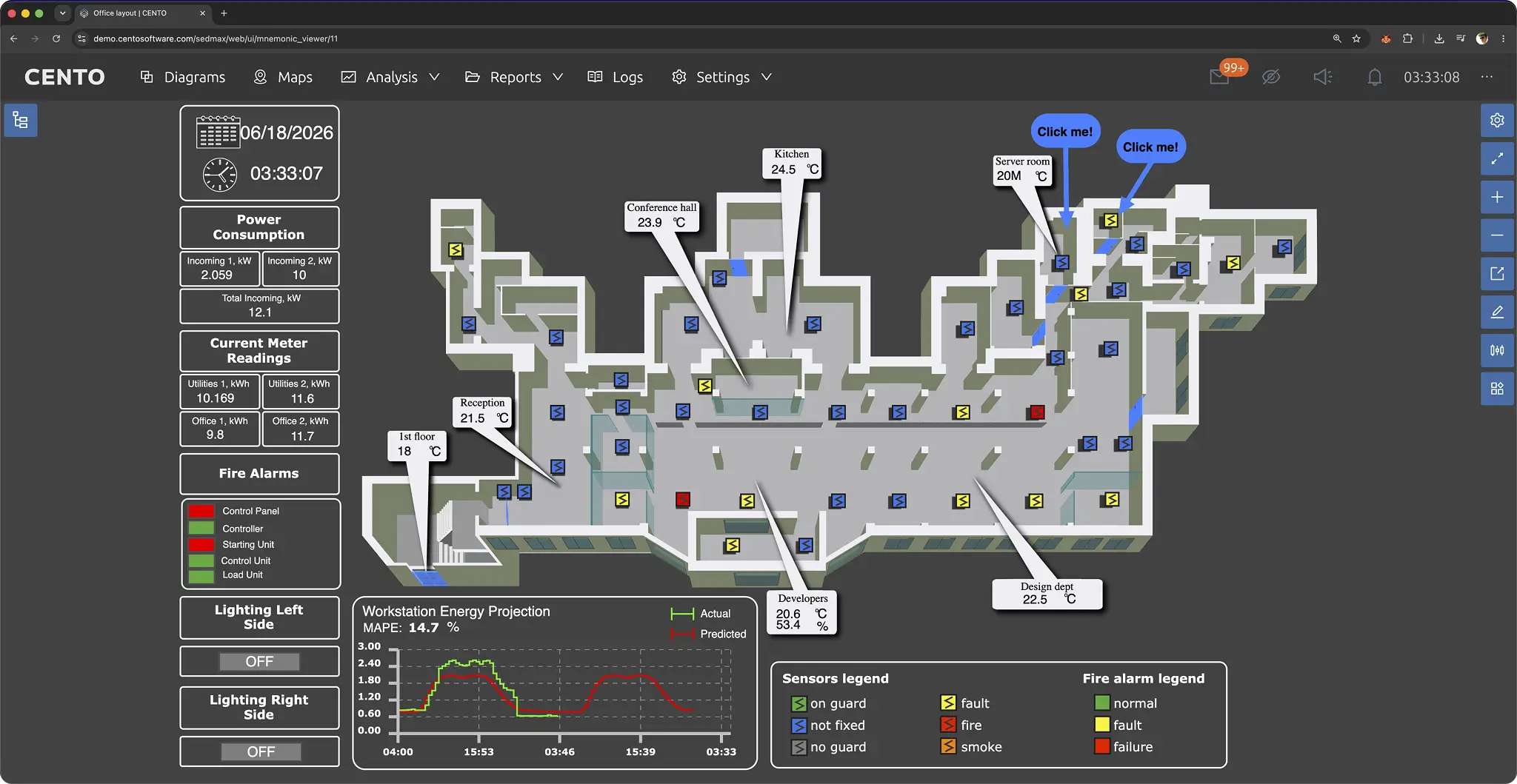
CENTO’s official documentation describes browser access, integration with existing SCADA, MES, and ERP environments, and support for open standards including OPC UA, MQTT, and SQL.[10] Its SCADA control and monitoring page lists live field-device acquisition, dashboards, remote control, alarms, notifications, and event logging. Teams can also examine industrial system integration, the CENTO Historian, and the industrial ROI calculator. These functions can support a coexistence or target architecture, but fit still depends on protocol details, control boundaries, security design, migration evidence, and acceptance criteria. A guided demo should focus on those site-specific decisions.
Frequently asked questions
When should a legacy SCADA system be modernized?
Modernization should be considered when supportability, recovery, security, maintainability, interoperability, data continuity, or workforce risks exceed the organization’s tolerance. Age is useful context but not a replacement rule. Begin with evidence: support status, tested backups, spare availability, dependencies, custom components, access controls, restore performance, and operational knowledge. The assessment should compare retain, extend, upgrade, staged replacement, and full replacement under consistent assumptions.
Can SCADA be modernized without stopping production?
Some functions can be modernized through overlays, phased deployment, isolated testing, or parallel validation while the existing control layer remains in service. That does not justify a universal zero-downtime promise. Physical changes, network transitions, database work, and transfer of control authority may require an approved operating window. A credible low-disruption plan defines isolation, test evidence, rollback triggers, discrepancy ownership, and plant authorization for every stage.
What should a SCADA migration inventory include?
Use two connected inventories. The asset inventory covers controllers, servers, workstations, software, firmware, network equipment, identities, and owners. The application inventory covers tags, scaling, units, screens, symbols, alarms, scripts, recipes, trends, reports, historian records, users, roles, certificates, interfaces, time sources, and custom components. Add dependencies, migration methods, test cases, exceptions, and acceptance owners so the inventory becomes a traceability tool.
Is web-based SCADA the same as cloud SCADA?
No. Web-based describes how the user interface is delivered, usually through a browser. Cloud-hosted describes where application or data services run. A browser can access an on-premises SCADA server inside a segmented plant network, while a hosted application may still depend on local gateways and controllers. Specify client, server, data, identity, command, and network-boundary locations separately before comparing architectures.
What belongs in a SCADA modernization RFP?
The RFP should cover functional scope, architecture, interfaces, performance, cybersecurity, availability, backup and recovery, migration, historical data, testing, training, documentation, support, upgrades, and decommissioning. Requirements should name evidence, acceptance methods, responsibilities, and exceptions. Ask suppliers to demonstrate how proposed functions behave under normal, degraded, failure, restore, and maintenance conditions instead of relying on feature checkmarks or unqualified standards references.
How should SCADA modernization TCO be calculated?
Model the complete lifecycle rather than purchase price alone. Include assessment, licenses, infrastructure, engineering, custom objects, interfaces, data migration, testing, security, training, temporary coexistence, support, upgrades, recovery, and decommissioning. Compare retain, extend, staged replacement, and full replacement over the same horizon. Use site baselines and sensitivity ranges for benefits because project scope, operating constraints, labor rates, and risk exposure vary by facility.
Sources
- Böhm, T., et al. “Model-Driven Legacy System Modernization at Scale.” ACM ReCode '26 author manuscript. 2026.
- Stouffer, K., et al. “Guide to Operational Technology (OT) Security.” NIST SP 800-82 Rev. 3. 2023.
- Nascimento, E. V., dos Santos, V., and Aroca, R. V. “An applied approach for integrating legacy PLC-based systems into Industry 4.0 environments using low-code platforms.” The International Journal of Advanced Manufacturing Technology. 2026.
- Bermpohl, F., et al. “Industrial study on holistic digital factory models.” Production Engineering. 2025.
- International Electrotechnical Commission. “IEC 62541-2:2026, OPC unified architecture, Part 2: Security Model.” 2026.
- Elshafei, B., et al. “Facilitating interoperability in manufacturing systems using digital twins: a multi-asset AAS system.” The International Journal of Advanced Manufacturing Technology. 2025.
- Rehman, H. U., et al. “A level-based classification of technical enablers for the realisation of self-configuration in production systems.” The International Journal of Advanced Manufacturing Technology. 2025.
- International Electrotechnical Commission. “IEC 62443-2-1:2024, Security program requirements for IACS asset owners.” 2024.
- International Electrotechnical Commission. “IEC 62443-2-4:2023, Security program requirements for IACS service providers.” 2023.
- CENTO Software. “What is CENTO and how it works.”