Most industrial facilities already collect enough energy data to act on. What they lack is a structured way to interpret it, one that separates genuine efficiency gains from the noise of changing production volumes, ambient conditions, and load patterns. Without normalised indicators, energy management becomes guesswork dressed as reporting.
Energy consumption figures mean very little on their own. A plant that used 8% more electricity last month than the month before might be celebrating a productivity breakthrough or covering up a serious inefficiency; the raw number cannot tell you which. The same output produced at higher ambient temperatures, on a longer shift pattern, or with a different product mix will always look different in an energy report, even if nothing about operational efficiency changed.
This is the problem that Energy Performance Indicators are designed to solve. Rather than tracking absolute consumption, EnPIs normalise energy use against the variables that legitimately explain it. The result is a figure that reflects how efficiently energy is being converted into useful output, and one that remains comparable across time periods, sites, and operating conditions.
ISO 50006 provides the technical framework for constructing these indicators correctly. It specifies how organisations should identify relevant variables, build baselines, validate models, and maintain the indicators over time. What it does not do is connect that methodology to the operational data infrastructure most industrial plants already have. That connection is where EnPIs either deliver value or stall in spreadsheets.
This guide covers what EnPIs are, how they work as a normalisation mechanism, where they have produced measurable results, and how to implement a working framework, starting with data sources your facility is almost certainly already collecting.
Why do energy managers struggle to prove performance improvement without EnPIs?
The attribution problem is at the heart of industrial energy management. When output increases and energy consumption rises with it, that is expected. When output stays flat and consumption rises, that is a problem. But when both shift simultaneously, as they almost always do across a real operating year, an energy manager without normalised baselines cannot separate signal from context.
Consider a manufacturing line that increased throughput by 20% while energy consumption remained flat. Without a normalised baseline, this looks like stable performance. With one, it reveals a 17% improvement in energy intensity: a result worth reporting to management, worth protecting through operational discipline, and worth using as evidence in capital allocation decisions. The raw figure erases that story entirely.
Baseline measurement compounds this. When energy managers cannot document pre-intervention performance with sufficient rigour, any post-intervention improvement becomes disputed. Attribution dissolves under audit. Efficiency programmes that genuinely delivered results get credited to production scheduling changes, seasonal variation, or simple regression to the mean, and future investment cases suffer for it. Establishing a defensible pre-implementation baseline is not an administrative requirement; it is the mechanism that makes energy performance legible at all.
Fixed operating schedules create similar blind spots at the equipment level. Many industrial systems run on predetermined profiles rather than demand-responsive logic, which prevents them from capturing the full benefit of load-shifting or off-peak optimisation. The efficiency potential exists in the asset; the measurement and control framework to exploit it does not.
What are Energy Performance Indicators and how does ISO 50006 define them?
An EnPI is a quantitative value that an organisation uses to monitor and measure energy performance. The simplest form is an energy intensity ratio: energy consumed divided by a relevant output variable, such as units produced, tonnes processed, or square metres conditioned. More sophisticated forms use regression models that account for multiple independent variables simultaneously.
ISO 50006 sits within the ISO 50001 energy management system framework and provides the technical methodology for constructing EnPIs that are defensible, consistent, and actionable. Its core contribution is the concept of the Energy Baseline: a quantified reference point established from a defined measurement period, against which all subsequent performance is compared. Without a baseline constructed to ISO 50006 principles, an EnPI is a ratio without a reference, and performance claims cannot be verified.
The standard requires organisations to identify relevant variables: the factors outside an energy manager's direct control that legitimately affect consumption. Production volume and ambient temperature are the most common, but the relevant variables differ by process. A compressed air system's consumption may track primarily with production rate. A chiller plant's consumption tracks with outdoor wet-bulb temperature and occupancy. Getting the relevant variables right is not a modelling exercise; it is a domain knowledge exercise that precedes modelling.
Static models that ignore relevant variable changes will systematically misattribute normal operational variation as either improvement or degradation. The standard's normalisation mechanism corrects for this by adjusting the baseline energy figure to reflect the conditions that actually occurred, so the comparison is always like-for-like.
Energy Baseline: A quantified reference of energy use over a defined period, adjusted for relevant variables, against which current performance is measured to determine whether genuine improvement has occurred.
ISO 50006 also covers model validation, the conditions under which a baseline must be recalculated, and the treatment of static factors: significant permanent changes to a facility, such as major equipment replacement, that require the baseline to be reset rather than adjusted.
How do EnPIs work as a measurement and normalisation mechanism?
The practical mechanics of an EnPI model depend on what you are trying to measure and how many variables explain the energy use of that system. For simple processes, a single-variable linear regression against production volume is often sufficient. For more complex systems, such as HVAC, compressed air, and refrigeration, multivariate models are required.
In building and HVAC contexts, the Building Load Coefficient plays a specific role in formalising this relationship.
Building Load Coefficient (BLC): A normalised variable, ranging from 0 to 1, that evaluates a building's energy efficiency by comparing power use to ambient temperature, indicating how effectively the building retains energy.
The BLC connects ambient conditions to the actual energy required to maintain setpoint temperatures, making it possible to distinguish between consumption driven by weather and consumption driven by equipment performance or control decisions. A scheduling heuristic that incorporates both temperature deviation from target and the BLC can calculate the required operating hours for a heating or cooling system under any given ambient condition, and from that, determine whether actual consumption is above or below the normalised expectation.
The same principle extends across industrial contexts. A piecewise linear approximation of a system's efficiency curve, whether that system is a compressor, an electrolyser, or a chiller, allows dispatch and scheduling models to account for the non-linear relationship between load and efficiency. Systems that operate near minimum load often have very different efficiency characteristics than those operating near peak. A flat efficiency assumption in the model will produce a normalised baseline that is either systematically optimistic or systematically pessimistic, depending on typical operating conditions.
For EnPI purposes, the implication is that the energy model underpinning the indicator must reflect the real operating curve of the equipment it covers. Generic benchmarks or industry averages are rarely accurate enough to serve as regression inputs. The model needs to be calibrated against historical data from the specific asset, under the specific operating conditions, at the specific site, and that calibration requires a historian or SCADA data feed, not a datasheet.
Once calibrated, the model generates an expected energy figure for any given set of conditions. The EnPI is the ratio of actual to expected consumption. A value below 1.0 indicates better-than-baseline performance. A value above 1.0 indicates degradation. The deviation, multiplied by the energy price and the volume of energy consumed, converts directly into financial impact: a figure management can act on.
Where have EnPI-based programmes delivered measurable energy savings?
The evidence base for structured energy performance measurement spans commercial buildings, industrial facilities, and infrastructure-scale systems. The common thread across successful implementations is the same: normalised indicators made performance visible in a way that raw consumption data could not.
In commercial building deployments, integrated prediction-based control strategies operating against normalised load baselines have delivered approximately 9.9% energy cost savings in real building automation system deployments. The key factor was not the prediction accuracy alone (a mean absolute error of 12.5% in cooling load forecasting is not especially precise) but the combination of prediction with rule-based control logic that allocated stored energy according to a ranked priority sequence. The normalised baseline made it possible to determine whether each operating decision was improving or degrading performance against the expected figure.
In energy community and grid-scale contexts, demand-response programmes that align equipment operation with renewable generation have demonstrated renewable energy share increases of 15% compared to unoptimised baseline operations, and in wind-dominated scenarios, generation-matching control approaches have achieved up to 95% self-sufficiency by exploiting building thermal inertia. These outcomes depend entirely on having a performance indicator that separates the contribution of scheduling decisions from the contribution of ambient renewable availability; without that separation, the programme's value cannot be measured or defended.
At the system optimisation level, prediction-free coordinated frameworks for energy storage management have reduced operational costs by approximately 30% compared to conventional online optimisation approaches. The 24–29% cost reduction attributable specifically to moving from prediction-dependent to prediction-free methods illustrates how much value is embedded in the methodology choice, independent of hardware changes.
In each case, the measurable outcome was contingent on a clear definition of the baseline and a normalisation mechanism that made the comparison valid. Energy savings claimed without these foundations tend not to survive audit.
What performance benchmarks should organisations target when setting EnPIs?
Benchmarks serve two purposes in an EnPI framework. They define what good looks like for a given process type, and they set the improvement target against which the organisation's energy management programme is measured. Getting both wrong leads to either complacency or unachievable targets.
For new EnPI programmes, the appropriate starting benchmark is the organisation's own historical performance over a representative baseline period, not an industry average. Industry averages aggregate too many variables to be directly applicable to a specific facility, and they tend to obscure the difference between facilities that have invested in efficiency and those that have not. A baseline drawn from 12–24 months of your own operational data, adjusted for relevant variables, gives you a defensible reference that reflects your actual starting point.
Once the baseline is established, improvement targets should be grounded in what the data shows is achievable. Chance-constrained optimisation studies in energy storage management have demonstrated average electricity payment reductions of 17.4% through better pricing and dispatch methodology, with total system cost reductions of 3.9%: figures that become more significant as renewable and storage capacity increases. These are not aspirational targets; they are outcomes from structured programmes that had clear performance indicators.
For facilities using predictive scheduling, normalised benchmarks that account for tariff structure as well as consumption volume become important. A facility operating under a time-of-use tariff where daytime rates are substantially higher than off-peak rates needs an EnPI that captures not just how much energy was used but when it was used relative to the tariff curve. A flat intensity ratio will miss the cost performance dimension entirely.
Early-stage EnPI programmes should build in appropriate uncertainty margins. Benefit projections in the first implementation phase benefit from margins of 20–30% to reflect the variance inherent when limited operational data is available. As the programme matures and data accumulates, those margins narrow and the indicator becomes a reliable management instrument rather than an estimate.
Concept Drift: The phenomenon where a model's predictive accuracy degrades over time as real-world data conditions shift from those present in the training period, requiring periodic recalibration of the normalisation model.
Concept drift is a practical concern for any EnPI model that uses statistical regression. A model calibrated in one production season may not remain accurate across major changes in product mix, equipment age, or operating hours. Scheduled model review, at minimum annually or triggered by sustained deviation from expected performance, is part of maintaining an ISO 50006-compliant indicator.
Have something in mind to discuss?
We're here to help you find the answers. Let's talk.
How to implement an EnPI framework in six practical steps
Implementation does not start with software selection. It starts with scope definition and data availability assessment. Most industrial facilities already have the data they need; the gap is usually in how that data is structured, labelled, and made available for analysis.
Step 1. Define scope and boundaries. Identify the energy systems you want to measure: the whole facility, a production line, a utility system, or a specific asset class. Scope determines which meters, sensors, and PLCs are relevant data sources, and which relevant variables need to be captured alongside energy data.
Step 2. Identify relevant variables. For each system in scope, document the independent variables that legitimately explain energy use. Production volume, ambient temperature, occupancy, equipment loading, and operating hours are the most common. This is a domain knowledge step that requires input from process engineers and maintenance teams, not just the energy manager.
Step 3. Establish the measurement period. ISO 50006 recommends a baseline period that is representative of normal operations. Twelve months is the minimum for most facilities, as it captures seasonal variation. Periods that include significant shutdowns, major maintenance events, or atypical production runs should be excluded or flagged.
Step 4. Build and validate the normalisation model. Regression analysis against the identified relevant variables produces the baseline model. Validation checks that the model explains a sufficient proportion of variance and that residuals do not show systematic patterns: patterns that would indicate an important relevant variable has been omitted.
Step 5. Calculate and monitor the EnPI. The ratio of actual to modelled energy consumption, tracked over time, is the EnPI. Mid-period correction mechanisms, analogous to intraday model updates that recalibrate predictions based on observed conditions, improve accuracy in systems where relevant variables shift during the measurement window rather than being known at period start.
Step 6. Review, recalibrate, and act. The rule-based logic for responding to EnPI deviations should be defined before deployment, not after. When the EnPI signals degradation, the protocol for investigation and correction should be clear. When it signals improvement, the mechanism for attributing and documenting that improvement should be equally clear, both for internal reporting and for external verification.
Benefit projections in early phases should carry explicit uncertainty acknowledgements. Programmes that claim precise savings figures from a two-month implementation are overstating their evidence. Accuracy improves as operational data accumulates.
How do EnPIs connect to broader energy management systems and digital tools?
An EnPI is only as good as the data feeding it. In practice, the most common barrier to ISO 50006-aligned EnPI programmes is not the methodology; it is access to clean, contextualised, time-aligned data from the operational systems that hold the relevant variable information.
SCADA systems, PLCs, building automation systems, and energy meters each hold pieces of the picture. A production historian records output volumes. A weather station or grid signal records ambient conditions. A meter records consumption. Without integration, these streams sit in separate systems on different time bases with different tag structures, and the energy manager reconciles them manually in a spreadsheet that nobody trusts.
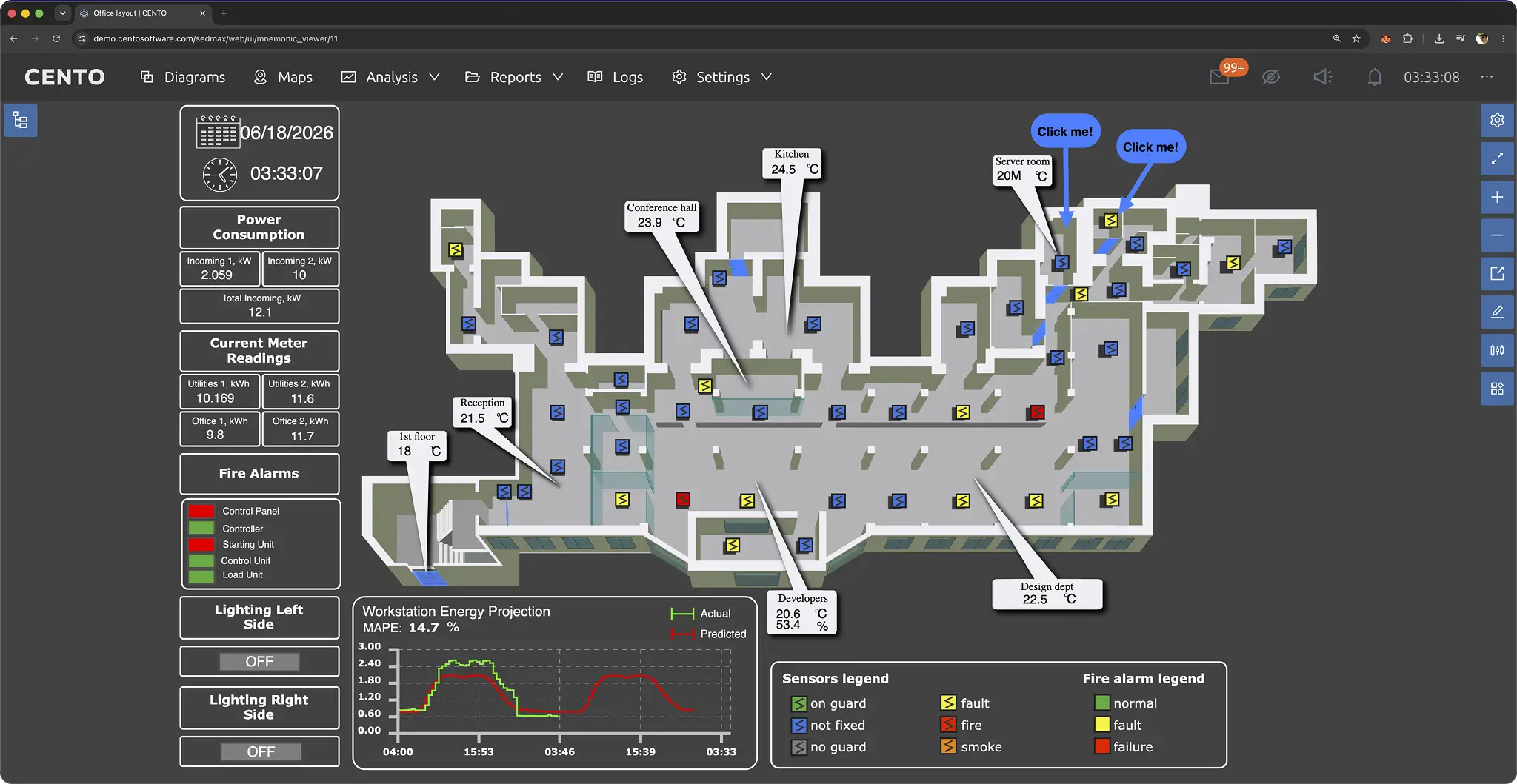
Digital platforms that unify SCADA, historian, and metering data into a single operational model make EnPI construction substantially more tractable. When production volume, ambient temperature, and energy consumption are available on the same time axis with consistent tagging, regression modelling becomes a data science task rather than a data engineering project. CENTO connects these sources without requiring replacement of existing infrastructure, creating the data layer that EnPI models need to function reliably.
Transparency in performance metrics also matters at the institutional level. Programmes that surface three core metrics (operational status across a 24-hour window, the percentage of renewable energy consumed in the previous day, and the improvement in renewable utilisation against baseline) demonstrate that structured performance indicators change behaviour as well as record it. Visibility drives accountability, and accountability drives action.
Integration with broader energy management systems also enables automated alerting when EnPI values breach defined thresholds, replacing the end-of-month report review with real-time operational awareness. A deviation that is caught within hours can be corrected before it compounds. One that surfaces in a monthly report becomes a retrospective record of avoidable loss.
Clear next steps you can take with CENTO
The first step is connecting the data sources your facility already has. SCADA systems, PLCs, energy meters, and production historians each hold fragments of the information an EnPI model needs. CENTO's integration layer connects these systems via OPC-UA, Modbus, and REST without replacing existing infrastructure, placing production volume, ambient conditions, and consumption data on a shared time axis where regression modelling becomes practical rather than aspirational.
Once data sources are unified, CENTO establishes a normalised operational baseline across your energy systems. The CENTO platform contextualises raw meter and sensor data against production orders, shift patterns, and equipment states: the relevant variables that ISO 50006 requires any valid EnPI model to account for. This baseline is the reference point that makes all subsequent performance comparisons meaningful.
With a baseline in place, the next step is identifying where the largest gaps between actual and expected consumption are occurring. CENTO's industrial energy monitoring surfaces these deviations in real time, ranked by magnitude and linked to the operational context that explains them. An anomaly that appears in a monthly spreadsheet review can instead trigger an alert within hours of the deviation beginning, before it compounds into a significant loss event.
Prioritisation is practical when the data is structured. Not every deviation warrants immediate intervention; some reflect normal variation within model uncertainty bounds. CENTO's data contextualization layer links energy deviations to specific equipment states, production orders, and operating conditions, making it straightforward to distinguish between a genuine efficiency problem and a legitimate relevant-variable shift. This changes energy management from a reporting function into an operational one.
Tracking results over time against real operating conditions, not against fixed calendar periods, is where ISO 50006 compliance and genuine performance improvement converge. CENTO maintains the normalised performance record that makes energy savings attributable, auditable, and defensible. As the dataset grows, model uncertainty narrows, and the EnPI becomes a reliable instrument for capital allocation decisions and regulatory reporting alike.
Explore what an EnPI framework looks like with your own operational data in the CENTO demo environment, or book a guided walkthrough to discuss the data sources and system boundaries that apply to your facility.
Frequently asked questions
What is an Energy Performance Indicator (EnPI)?
An EnPI is a quantitative measure used to monitor and evaluate energy performance relative to a normalised baseline. Unlike raw consumption figures, an EnPI adjusts for relevant variables such as production volume, ambient temperature, and equipment loading, so that performance comparisons across different time periods or operating conditions remain valid. ISO 50006 defines the methodology for constructing, validating, and maintaining EnPIs within a formal energy management system.
How does ISO 50006 relate to ISO 50001?
ISO 50001 is the overarching energy management system standard, specifying requirements for policy, objectives, and continual improvement. ISO 50006 is a supporting technical document that provides detailed guidance on constructing Energy Performance Indicators and Energy Baselines: the measurement infrastructure that makes ISO 50001 performance claims defensible. An organisation certified to ISO 50001 uses ISO 50006 methodology to build the indicators that demonstrate compliance.
What is an Energy Baseline and why does it matter?
An Energy Baseline is a quantified reference of energy consumption over a defined historical period, adjusted for the relevant variables that legitimately influence use. It is the denominator against which all subsequent EnPI calculations are made. Without a robust baseline, improvements cannot be distinguished from normal operational variation, and energy savings claims cannot survive external scrutiny or internal audit.
What relevant variables should be included in an EnPI model?
Relevant variables are factors outside direct operational control that legitimately explain energy use. Production volume, ambient temperature, occupancy, equipment loading, and shift patterns are the most common in industrial settings. The specific variables depend on the process: a compressed air system tracks primarily with production rate, while a chiller plant tracks with outdoor wet-bulb temperature. Identifying relevant variables is a domain knowledge task that precedes any statistical modelling.
How do you validate that an EnPI model is accurate enough to use?
Validation checks that the regression model explains a sufficient proportion of variance in historical energy data and that residuals, the differences between predicted and actual consumption, do not show systematic patterns. Systematic residuals indicate an important relevant variable has been omitted. A model with unexplained systematic patterns will produce an EnPI that misattributes normal operational variation as either improvement or degradation.
What happens when process conditions change significantly after an EnPI is established?
ISO 50006 distinguishes between relevant variable changes, which the normalisation model handles automatically, and static factor changes: major permanent alterations such as significant equipment replacement or process redesign. Static factor changes require the baseline to be reset rather than adjusted, because the fundamental relationship between inputs and energy consumption has changed. Concept drift, where gradual statistical shifts erode model accuracy, requires scheduled recalibration rather than a full reset.
Which industries benefit most from a structured EnPI framework?
Any sector where energy represents a significant share of operating cost and where production volume or process conditions vary substantially over time benefits from normalised performance indicators. Manufacturing, food and beverage, chemicals, pharmaceuticals, commercial real estate, and data centre operations are common deployments. The framework is also applicable to utilities and energy communities where benchmarking renewable utilisation against a normalised baseline is a regulatory or commercial requirement.
How does CENTO support EnPI implementation?
CENTO connects existing SCADA, PLC, historian, and metering data into a unified operational data model, placing production volume, ambient conditions, and consumption figures on a shared time axis. This provides the structured data layer that ISO 50006-aligned EnPI models require. CENTO's energy monitoring layer tracks deviations from normalised baselines in real time and links them to operational context, enabling energy managers to investigate and respond to performance gaps without waiting for end-of-period reports.
How long does it take to establish a valid Energy Baseline?
ISO 50006 recommends a baseline period representative of normal operations, with 12 months as the practical minimum for most facilities. This duration captures seasonal variation in ambient conditions, production schedules, and demand patterns. Periods containing major shutdowns, commissioning activities, or atypical production runs should be excluded or flagged. Shorter baseline periods can be used where operational conditions are highly stable and well-documented, but they carry higher model uncertainty.
What should an energy manager do when an EnPI signals performance degradation?
The first step is determining whether the deviation falls within the model's normal uncertainty bounds or exceeds them. If it exceeds them, the investigation should follow a defined protocol: check for measurement anomalies, review recent equipment maintenance records, examine production schedule changes, and compare operating conditions against the relevant variable inputs. A structured response protocol defined before deployment prevents the common pattern of degradation being noticed in a monthly report only after the loss has already accumulated.